


5 mistakes applicants make when applying for jobs
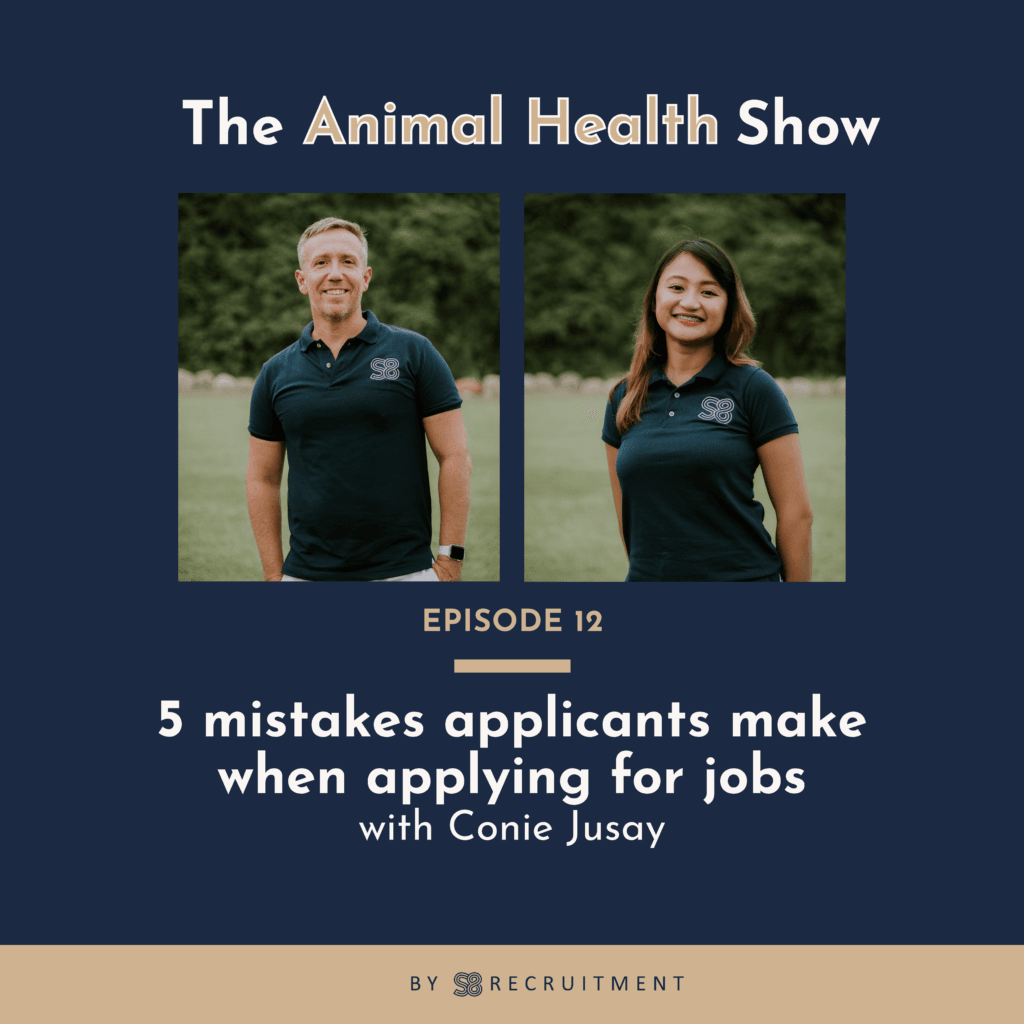
Are these common job application mistakes costing you interviews?
In this episode of The Animal Health Show by S8 Recruitment, Shannon and Conie share the five biggest mistakes job seekers make and the simple changes that can help your application stand out.
SHOW NOTES
TRANSCRIPT
* Transcript created by AI – may contain errors or omissions from original podcast audio
Last time we talked about seven hacks to make your CV stand out.
This time we’re talking about some of the probably the five big mistakes applicants make in applying for jobs. We’ve talked about some of these things between us all and we thought, it’d be good to let the viewers out there and listeners know some of the things that we see or that we’ve picked up over the time that, that may really help them.
Welcome to The Animal Health Show by S8. I’m your host, Shannon Wood, and this is where we talk about the latest trends shaping the animal health industry. We’ll be sitting down with leading voices from across the sector, sharing practical insights to help you grow your animal health business, build a stronger team, or land your dream role.
If you’re looking for your next dream job, or you’re ready to hire your next standout team member, reach out to us at S8 Expert Recruitment Solutions. You’ll find our contact details in the show notes for today’s episode. All right, let’s talk animal health
Welcome back, Conie. After last time we had you on, I think it was one of our highest viewed podcast and it looks like everyone loves to hear from you. And so-
Oh, thank you …
back to The Animal Health Show.
But anyway, how are you?
I’m good. Really good. How about you?
Yeah, great. It’s Friday. Sun is shining. It’s a beautiful day out here while we’re recording this. But, I’m excited to get you back in ’cause I think this is one of those things that, as I mentioned before, we speak about, we’ve, we’ve looked into and I think some of these tips might just help some of these people when applying for some of the roles.
And the first one we had was like the spray and pray approach. Oh my God, over 20 years the amount of times I’ll be looking at a cover letter and it says, “Oh, hi, Jack. I’m really excited to apply for a furniture removal position.” And you’re like, “My name’s Shannon, and this is a ruminant nutrition position.”
And like it’s, you can just instantly, I don’t know, I don’t particularly wanna read on from there. I’m already assuming this is just a, an absolute car crash. Not right, complete waste of my time. That’s my first initial impressions and it might not be maybe after 20 years of doing this I’m a bit pessimistic and I’m just thinking, “I don’t wanna waste my time.”
So when little things like that come in I feel like someone’s just gone out and copied, 50 odd email addresses and just applied for everything and just and yeah, just done this big spray. Have you come across anything like that yourself?
Yeah, I did. It’s always happening that I received CVs that are too generic.
Yeah. So candidates fail to like highlight other skills or experiences that would use as an edge for them to stand out in the application. So yeah, they, it’s just like very safe and general and the details are very general, so- Yeah, it would be better if they tried to match their skills and they were, they al- also highlight their career experience to the job that they’re applying for.
Totally. Yeah. That’s definitely another one that I see as well was that, really having that that right sort of experience for the right role as well. I get that some people wanna- You know, move from different industries and, wanna go and try something different.
And especially, they might have a pet at home and think, “Oh my God, I wanna work with animals.” which, is wonderful, but it’s not always the right thing, right? Just ’cause you got a pet at home doesn’t mean you’re gonna be a great- … veterinary sales rep by any means.
Yeah definitely try and, keep that experience sectors highlight those immediately and, yeah, have that work history aligned. What about any one thing that you’ve seen, like mistakes that candidates might make when applying for roles?
Mostly it would be, like, candidates doesn’t, read the job ads, so they just apply automatically.
Yeah.
And yeah, they don’t know about the role, so it would take a long process for us. ‘Cause like for example, when we reach out to them and then they’re gonna ask us, “For what role is this?”
Yeah. Or yeah, or you know as a recruiter you already know that the CV is not qualified. The background of the candidate is not qualified. So y- you’re gonna like wonder, “Is he even reading the job ad?”
Yeah.
I know that some is like just trying their luck.
But then like for others it’s such a red flag when you call them and then they don’t know what they’re applying for. It’s a like waste of time for the recruiter.
I I know exactly what you mean. And but on the other side, I also get the they call so a candidate might call up and just say “Look, hey I applied for the role.”
And I’ll be like, “Okay, which role?” And they’re like, “The job.” And I’m like we have we’ve got like-” The job that you
posted. Yeah.
We’ve got 10 jobs. And ” Oh, the one, the sales one.” You’re like eight of them are sales roles.” like- And you’re like, and then you kinda gotta pull teeth like, and then finally get down to the answer.
And it’s, “All right.” And he’s “What do you wanna know about it?” “Oh, how much is it?” You’re like the salary is, in the job ad.” w- “What’s it exactly doing?” You’re like as it says in the job ad it’s looking after this territory. Could be Sydney North up to Coffs Harbour and down.
Dealing with vet clinics.” And I was like, again “Did you even read the job ad before calling?” if this is your way of making an impression to a recruiter to get in, then it’s… it can be quite frustrating sometimes.
Yeah. Yeah. A- another thing about that is, like, when they call, they say “Hi, I saw your post in SEEK, and then I’d like to know more about the role.” Yeah. And as a recruiter, it was like, “What do you want to know more?” It’s like everything was a- already stated in the job ad. Yeah,
And then so number one, w- you know, we sort of spray and pray.
Number two did you even read the job ad? The third mistake what I w- chatting to you about before was the rushed submission. I had to build a template because it happens so often. And it’s when people have applied for a job, so they’ve gone, “Yeah, I wanna apply for a role.”
But there’s no cover letter attached sometimes and no CV attached. Sometimes you might get the cover letter but you don’t get the CV and you’re like, this is great that you’ve got some sort of experience working in McDonald’s, but like I don’t really know too much more about you. And you wanna be like…
So I’ve got this template built in just “Oh, thanks for applying. Can you please send me your CV? If you’re still interested in, this job title.” th- that happens so often or ah, the mistakes sometimes. The what is it? Like we’ve got grammatical errors, we’ve got formatting and it might just be in the application email that they’re sending to us.
Have you seen any sort of other I don’t know, major sort of red flags or accuracy that sort of-
Oh in my case it’s very few.
Yeah.
But yeah, I’ve seen some candidates who have errors with spellings and grammar, so we have to really double-check before submitting them.
And I guess it’s that that’s really that first impression. Yeah … and you think, do you have high attention to detail? And you look at their application and you’re like, “Ugh,” do they care? Are they just trying to do it ’cause they need to fill it out and do it?
Is this what they’re actually gonna be like dealing with our clients- Yeah, true … If they’re actually applying for jobs like this? They … It … take a bit of time, take a bit of care. It, that, those extra details that you put into an application really sets the tone.
And again, if you’ve … I know sometimes you forget a CV or, an application, but I think that’s because they’re rushed. Or you’re trying to do it really quickly and get through too many. But just slow down, take your time, do it ’cause I really think those first impressions really count, for sure.
That’s actually true because, if I’m the client or I’m the recruiter and then the… I know there will be, like, a lot of mistakes on the CV, and I will know that it’s rushed. So-
Yeah …
it feels like I’m not really important. So yeah it feels like it’s you’re not that valuable enough that the candidate would spend time on double-checking the CV if it’s correct or if it’s a really an impressive one.
And aside from that, if, for example, they’re applying for a role in finance or in something administrative or clerical position- … and then there will be a lot of ta- typos or, and errors in the CV or the cover letter. So that would create an impression to the employer that, or the recruiter that, oh, he’s not fit for the role.
‘Cause by just seeing on the CV there’s already a lot of errors. What about if he’s gonna do the job? Yeah. He won’t be, like ef- effective as an employee.
Definitely. Look, there’s so many roles these days like even a sales rep, for example. You’ve got a CRM system that you need to fill in so you can document, what’s happened in that call.
And if you’re applying for a job that you really want and there’s all these initial mistakes in there you’re thinking, luckily they’re coming to us as recruiters and we can say, “Oi,” yeah. We need to sort this out. But ag- again, from that initial impression y- you’re like, oh, maybe we shouldn’t put them forward ’cause we’re just not sure whether they’re gonna actually be able to comply in terms of, that, that attention to detail in filling in some of these, CRM systems for some of our clients for whatever role they’re doing.
Yeah.
That’s a good one. Another one we had here, number four ignoring application instructions. So I personally, as a business owner have had some of these instructions that I’ve put in. So like one of the last ones we actually ended up looking for was so social media manager here for S8, and there was a couple of things we really wanted to have a look at was, number one, maybe their Instagram handle or some of the ones that they’ve managed before or maybe a bio profile.
A lot of creative people have their artwork on a on a system. And some of them were on QR codes that I could scan and it took me into showing me their portfolios of, a lot of the stuff that they’ve created, edited. But I guess w- without that, you’re like trying to go through all they’ve done and send a CV, which is fine.
But I think someone starting off in social media could have a really good skill set and without having some understanding of what their work looks like, more than any other sort of people that we deal with, yeah, without seeing that, for me, was really frustrating. ’cause, and again, their CV might have looked amazing and they just didn’t send that through.
You’re like, “Why? Why didn’t you just…” ’cause they’ve got it. When I ask them, “Oh yeah.” And I’m like, “Why didn’t you just send it like we asked?” I guess that can be quite frustrating and, creates instant doubt of how well they’re gonna perform in the job again.
So for me, really ignoring sort of some of those application instructions is a big no-no. Make sure you read it, make sure if they’ve asked for, “Please send a photo,” or, “Please send,” I don’t know, something, whatever that is, your Instagram handle, LinkedIn, whatever that is, just do it.
Yeah. I don’t know. Have you come across any other sort of things that stand out to you that when we’re talking about ignoring the application process or instructions?
For me personally it’s the video interview. With our video interviews, there’s already instructions are placed on w- how you place your device, on what type of format you’re gonna use, and saving your document.
So and then w- if you’re gonna use a laptop or a phone in recording. So if they don’t follow the instructions, usually there will it will result to a problem in our videos- … that we’re going to submit to our clients. Sometimes it’s, the video i- the result is upside down or – Yeah
it should be, yeah, the face the head is in the o- other side. So-
Yeah …
yeah it’s really bad. And also, speaking of videos we also state there that they should look prepared and professional, at least to be presentable when we submit the video to the client, and to create a good impression.
But I don’t know, some just as if they just woke up or … And, a- you really want them to get that ’cause they have a really good background, they have a great achievement, but it’s just the video-
Yeah …
is.
I know. I I had one yesterday actually that stands out to mind, one of the videos that not that they just woke up, but in a very relaxed maybe pajama-looking outfit.
Look, I don’t, I’m not a fan, it’s not me of having piercings in, on, on your face, which is, each individual is up to them. But, if you’re going for a professional job interview for a big global conservative animal health pharmaceutical company and I sent them a video of you in your pajamas with, not looking, really presentable with all the piercings left in I don’t even need to forward that on.
I just I I know what clients might say before. It’s just, they’re just too conservative. And I just find that, yeah, to your point, looking very presentable. Even though this is a video and, you are at home, you are relaxed it doesn’t take much just to make a couple of tweaks just to really make yourself be a bit more stand out a little bit more.
Yeah
so number five I think you mentioned this to me, which when applying for a role, it was one of the ones we spoke about was, and with people not putting maybe some of their contact details on it, and we call it mystery location CV. As recruiters, we’ll go through, we’ve got hundreds of CVs and we might be looking for, say, a sales rep in Melbourne West, for example.
And, you look at the CV “Where do you live?” I really need someone ideally Geelong so they can get across to Warrnambool or come up a little bit and that’s, that, that would be the sweet spot. And someone living in maybe Tullamarine, is far north cons- you could argue it’s west or, someone on the east side of Melbourne going, “Yeah, no, it’s fine.
I’m just gonna travel over there every day. I don’t mind the travel.” the client does. The client doesn’t want you to be traveling, get stuck after six months, go, “You know what? The traffic every day is a grind. It’s an hour and a half before I can even get on territory, which means I need to get home.
I’m not getting paid for all this extra travel time. I’m spending away from my family doing maybe kid drop-offs,” or whatever you need to do. And after a while it just, it bears down. So look, they’re not gonna consider you. So in terms of applying for us, we’re like don’t… You don’t need to put your full address in there.
Definitely put an a suburb of where you are so we can, make sure and it’s just one of those extra box ticks. And even if you are in that territory or already living in, say, Geelong, and you don’t put it there, it- it’s a bit annoying oh maybe they’re not there and maybe you might get put to the bottom of the pile or the maybes.
It’s not just a, “Oh yeah let’s jump on a quick call and find out, a little bit more about you,” ’cause you just don’t have that little bit of information in there. And I’m sure there were some more things on that you were talking to me about before as well.
Yeah. I… ‘Cause like I’m always like hiring for vet nurses- Yeah … and they are required to work on site. So this is one of the main issues that I’ve encountered to my candidates where they don’t place their location. ‘Cause I have to make guesses if they are located in this area and it’s really time-consuming on my end where I have to call them.
And then like vet nurses are hard to call because when they’re on duty they’re not allowed to use their phones. Yeah. So you have to make sure you call them at lunch break or after the wor- after working hours. ‘Cause so it’s really like- Quite like a burden on my end ’cause it’s supposed to be we already processed you for the role, but then you got delayed because there was no location and then we ended up catering another candidate and that candidate moved forward for an interview because they already specified their location.
So what if the client is only hiring for one slot or one position- … and then it’s just because you were not able to put your location, we preferred to choose the other candidate, ’cause like we, it’s a rush hiring. It’s a rush hiring and then we need to fill the role as soon as possible.
So yeah, it’s opportunity cost. It would be better. Just make sure to put your location.
Definitely. Yeah, I love that one. And just while I’m on there, just, another thing that’s just popped up. Sometimes, you’re not gonna believe this, but sometimes some of the other information like a phone number might be buried all the way down the very tiny little writing on the last page and you’re like, if we’re gonna get in contact with you just to have a little bit more of a talk through the role and your experience, make sure everything’s aligned, then have your contact details right at the front.
Imagine this was you’re looking for, I don’t know, you want to buy some spoons and you go onto a website to buy some spoons and you’re like, “I found the perfect spoon,” but then I’m like, “How do I get in contact with this company who are selling these spoons?” And you’re like trying to find a phone number and i- it’s surely it should be right up the front, big, center if we like the look of you and get in contact with you just like you would be if you were buying something.
But this time, you’re the product you need to present yourself like that. Be contactable or at least an email address but, ideally both on there as well. So yeah, address, email, phone number and some contact details as a, as an absolute bare minimum right up the top.
Big, nice and easily defined. So it’s we can get in contact with you and talk more about the role and your suitability and see if there’s a, see if there’s a match and obviously it’s got to be right for you as well as it’s right for the company as well, right? Hence we have these sort of initial conversations just to make sure everyone’s aligned and there’s some I don’t know, it’s, the word’s out these days but I still, I’m really old, I still love it but yeah, there’s some synergy there with the company and what you’re looking for.
But that’s it. It’s a nice and short, sweet one with us today, Conie. I really appreciate you coming back on again. Even if you’re dragged back in here . Just joking. But no it’s been really good and fun. Any other final things, or do you think we’ve covered everything?
Yeah, I think we already covered everything. But just to take away, we should always make our CV impressive as possible because it can be used as a marketing tool in order to sell ourselves for a position and opportunity.
Yeah. Yeah. Definitely. Thanks so much again. I really appreciate your wisdom here. I know everyone loves hearing from you appreciate your time. And until next time, thanks for joining us here on The Animal Health Show. Until next time.
Thank you. Have a good day. Bye.
Thanks so much for tuning in to today’s episode of The Animal Health Show by S8. If you found the value in this conversation, please share it with your colleague, an industry mate, or on social media so we can keep the discussions moving across the sector. If you’d like to get in touch, all of our details are in the show notes for today’s episode.
I thank you for listening, and I look forward to chatting with you again in the fortnight
* Transcript created by AI – may contain errors or omissions from original podcast audio