


The blueprint for a Global Animal Health career with Stephanie Armstrong
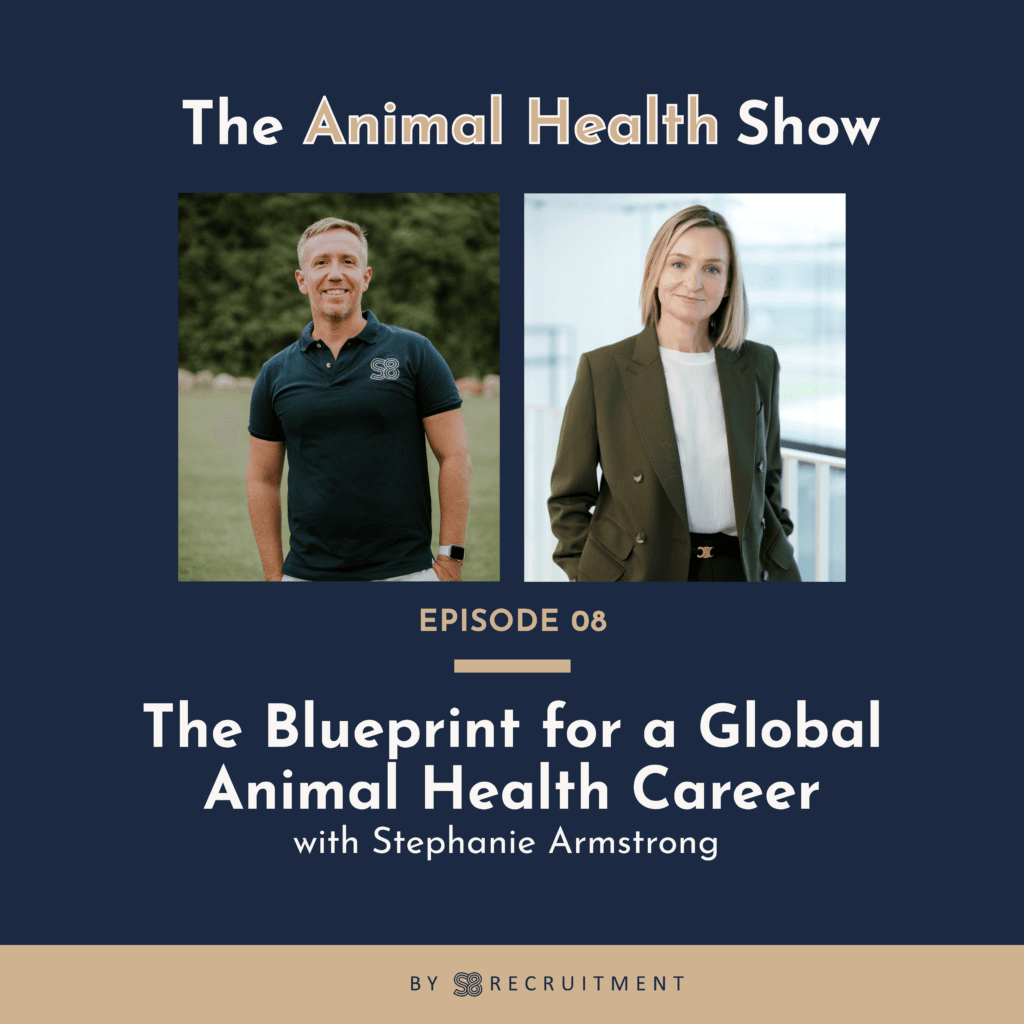
How do you go from veterinary practice to global leadership?
In this episode, Shannon chats with Stephanie Armstrong, President of Asia & Africa at Zoetis, on her journey from Sydney vet clinics to the global stage, and the lessons behind building a career in animal health leadership.
SHOW NOTES
TRANSCRIPT
* Transcript created by AI – may contain errors or omissions from original podcast audio
Are you a veterinarian or are you currently already in the industry as in a corporate level and you’ve wondered, “How do I move from, say, a vet into the industry or moving from that industry into the global platform?” If questions like this arise in your career at the moment, you should probably have a listen to this.
She started as a vet. She’s now the president of Asia and Africa of the world’s leading animal health company. So how do you go from a clinic in Australia to the boardroom of a global giant?
Stephanie Armstrong sat down with me and has spent 20 years mastering the transition from technical expert to corporate visionary. She’s lived it, breathed it, and led across four continents. Today on the show, Steph shares her unteachable lessons.
Welcome to The Animal Health Show by S8. I’m your host, Shannon Wood, and this is where we talk about the latest trends shaping the animal health industry. We’ll be sitting down with leading voices from across the sector, sharing practical insights to help you grow your animal health business, build a stronger team, or land your dream role.
If you’re looking for your next dream job, or you’re ready to hire your next standout team member, reach out to us at S8 Expert Recruitment Solutions. You’ll find our contact details in the show notes for today’s episode. All right, let’s talk animal health.
Hello. Hi, Shannon. How are you? I’m really good. How’s things? Very good. Yeah, very good. Thanks for coming on. It’s really cool. I’ve been out of Australia now for, I think this is coming to our n- our ninth year, I think. Eight or nine years, something like that. But time just flies, yeah. It just, i- in a heartbeat, suddenly you’re nine years later going, “Oh my gosh. How did that happen?” Yeah, I know. I know.
I know. But you’ve, what, started your journey in Clinics of Sydney in, back in ’97. Oh. And then graduated- Oh my God … Sydney University. Yes. And then your career expanded from a global technical role not global, but you worked for a massive global business but, which was Pfizer Animal Health.
And then in Australia in your executive leadership, and we all know that- Zoetis today, and then you’ve been working in, what, Dublin, New York, London, and now you’re the regional president of Asia Pac and Africa, one of the, for one of the world’s leading animal health companies, and- Yeah … yeah. That’s pretty cool.
It’s super… Your background is, like someone that probably a lot of people just dream to have and be. Yeah, look, that’s you to say. But I think I’ve been very fortunate to be able to take advantage of opportunities as they’ve arisen.
And I think, a lot of what I see is just whether or not people are willing to take those risks, it’s not that I have some unique skill set that has unlocked, this opportunity. It’s just that I was willing to, put some risk into some of the moves that I made, and they’ve paid off.
And those o- I’ve been… A lot of it is timing. Are you in the right position- Yeah … at that moment the opportunity comes up, and you’re willing to take that risk, and the, your personal situation allows it, and all that kind of stuff. So yeah, I’ve been very fortunate. But I’m, I absolutely love having a global career.
It’s been, super exciting and interesting. And hopefully will continue to be yeah. Yeah. It must be a huge adventure. You’ve spent seven years in practice before moving to the corporate world with Pfizer, and then back in 2005.
And I was thinking, like from a, you’re a vet, and then at what point did you think that, you wanted to pivot from clinical into industry? Yeah. I would say that there wasn’t a s- single pivotal moment. You’re right. I was in clinical practice for seven, seven years or so throughout Australia, and I did the usual stint in the UK as well as a acting as a locum vet.
I al- I really did enjoy clinical practice. I enjoyed the problem-solving. I enjoyed the pet owner. And I was largely in companion animal practice, but the pet owner interactions. I enjoyed the teamwork, working in, practices with, alongside vet nurses and vets and et cetera. So all of that was really interesting.
I think what I got to though, after six or so years, is I had done some post-graduate training, and I thought I really wanted to con- just continue to challenge myself. And, like, how far… Just always, not necessarily chasing a particular role, but how far could I push myself to learn new things and try different things?
And I thought the next logical step for me when I was in clinical practice was to own my own practice. Yeah. And at that time in, in Sydney- That, I don’t know if it’s changed, Shannon. You would know better than I, but that’s no easy undertaking. Just getting, get- either buying a practice from someone else, the real estate costs, all the rest of it was just really challenging.
And I also didn’t necessarily wanna go into specialty. So I was actually, but I didn’t wanna give up again, I love this industry and and I really thought I invested so much in developing this skillset, I didn’t wanna walk away from it. So I remember I was in, in a practice and in Sydney and the Pfizer Animal Health rep at the time used to call in and see me.
And he mentioned, “Look, we’ve got this technical role, you should apply if you’re interested in just I think you, you would enjoy working in industry.” And at the time, I thought nothing to lose,” because I was interested in exploring what could more could of a career in animal health do.
What could it look like? But also I thought if I don’t like it, I just go back into practice.” that, that skill never goes away. So yeah, I moved over into Pfizer Animal Health at the time, and now 21 years later, here we are. So it, it didn’t… I never felt the need to go back into clinical practice.
But I’ve never really, in my mind, I’ve never really left it, because everything that I do on a day-to-day basis always seems to link back- Sure … into that setting. So it’s- Yeah … been an enormous s- benefit to have that background. I get asked this question all the time.
I’ve got vets that are vets and they come to me and they’re, like, looking at some of these things of what, w- what… Is there anything I can do or go study and I close my eyes and I take a deep breath and I’m like, look, sometimes I’ve seen some vets that have been really good.
They’ve gone off and done an MBA, and if you wanna go down marketing or you wanna go down certain commercial aspects,” sorry, “having a marketing or that sort of commercial educational background by getting an MBA has been…” from what I’ve seen across the board, f- a lot of them… ’cause you gotta go invest so much money into an MBA.
Yes. You wanna go down that path. So they- Yeah … and I’m like, but it’s, that’s definitely not for everyone, but I’ve definitely seen it help. So I’m like I don’t wanna say this is gonna do all these things, but the ones that have actually had really good results. And I’ve had multiple of them come, “I’m so glad you told me to do the MBA ’cause I’ve, now I wouldn’t be here- Yeah
if it wasn’t for you.” But I know- Yeah … you’re certainly one of those people that went and did an MBA, and I was just, really keen to understand, how crucial do you think it was having an MBA- Yeah … to bridging that gap from- clinical sort of thinking into sort of commercial sort of thinking as well.
Yeah. Look, and I totally get it. I possibly would’ve been one of those people, Shannon, that would’ve asked you that same question. ‘Cause I remember for a few years I was like, “Should I, shouldn’t I do it?” and I, my first role in industry was in a technical role- … of which you don’t need an MBA to do that.
In fact, the more specialized you are in your technical background, the better. But when I sat in that technical role for a couple of years and worked alongside marketing and thought, “That, that looks of interest to me,” then I started doing my MBA while I was working at Pfizer Animal Health at the time.
It certainly helped me develop a more rounded commercial I guess skill set, right? I would say that in terms of its difficulty, it is nowhere near as difficult as a veterinary degree. The veterinary degree and my pharmacology post-grad study was by far technically, intellectually more difficult.
So I d- I don’t think the MBA is an intellect- to me, it wasn’t a real intellectual challenge. It was a challenge on balancing work life, rounding out your skill set, all the rest of it and building that network. But it wasn’t technically difficult, but you’re right, it’s expensive and it’s a time commitment.
It took me four or five years, I think- Yeah … ’cause I was working at the time. But it was enjoyable. And I would say that you’re right. It doesn’t guarantee you a path in a commercial role or, senior leadership. But it certainly is no detriment. Yeah. And when people ask me, vets ask me that same question, I always position it in a way that it’s not just about you applying for a role.
You would be applying against a cohort of other applicants of which others will have an MBA. So it, to some degree it puts you alongside others to be able to compete for the role. You’re not gonna get that role just because you’ve got an MBA, but it’s- Of course … not gonna not, it’s not gonna disadvantage you, and it will at least put you on a par with others.
So it’s just these, all these skill sets and additional degrees, et cetera, just puts you in a better position to compete. But it, you’re exactly right. Yeah. They’re no guarantee. Yeah, I know. It’s always hard. I’m always like… That’s why I shut my eyes, yeah. And try what do you wanna do?
What do what do- What’s your vibe in terms of what gets you up and wakes… Do you like creative writing? S- Do you like doing these things? Do you like the- So true … dotting your I’s, crossing your T’s? There’s- Yeah … ’cause of vet, I feel like there’s so many op- there are options as a veterinarian to come into industry, and there’s different channels that you could go down.
So true, Shannon. Amazing, yeah. I mean- Yeah … I remember in my undergraduate, one of my last years of undergraduate, one of the lecturers at the time, when we all used to laugh about it, but he would always say, the vet degree is t- is a broad-based skill set.
It’ll just- Yeah … it’ll unlock this career. And yet when you’re doing a vet degree, or generally the reason why you sign up to do a vet degree is you’re gonna become a vet, right? Yeah. And so it took me a lot to what is he… what do they mean by that? We’re all gonna become vets, and the majority of us did in the first instance.
But you’re exactly right. That skill set that you get as an undergraduate is absolutely applicable in a broader business setting. And I got to that point. Those questions that you asked I think are really valid, where you say, “What is it that excites me?” “What do I wanna t- do, when I get up, i- in, in the morning?”
And I certainly moved from a point where, I had that technical skill set and initially that ro- that first role was really about providing technical support for vets using the Pfizer Animal Health portfolio. It would be training and education externally and internally. And then the more exposure I got to marketing, I was like…
and strategy, I was like, I’d actually… I think I’d… That interests me. Yeah. F- forming a future, of, for the industry. Assessing product fit against our industry. Deciding, in Australia at the time what products would s- solve what problems for vets. Where do we need to shape certain segments?
And that sort of started really interesting me. Yeah. And so that was the evolution of that. But you’re right. You have to ask yourself, if you’re looking at a career in industry, what excites me and what does this pathway potentially unlock? And it’s certainly a very varied outlook for sure.
I chose a commercial path, marketing and then general business management, but you can equally go into pharmacovigilance, you can go into R&D. There’s a n- plethora of- Reg … of options. And yeah, reg. And certainly, again, there’s a lot of people that come into industry that don’t have a veterinary degree but…
And they can do most of those roles. They can’t do a technical role. But a veterinary degree is as… I view it as a bit of a superpower for any role, yeah. There is nothing that you couldn’t do with that. Whereas if you don’t have that vet degree, there are certain things you are at a bit of a disadvantage on or you actually can’t do.
So it’s a huge unlock and a bit of a superpower if you wanna apply it in a different setting. And how hard is it, like- You know, like having a thinking of a clinician from a vet sort of mindset to start thinking across to, going down that sort of commercial strategist type mindset.
Yeah. Look, I… You meet lots of potential applicants, right? So you would have a really good perspective on this. I didn’t find it difficult. Because, again, when you’re in practice, often what you’re doing is, you’re problem-solving you’re trying to be pragmatic, you’re thinking, what could go wrong in this setting?
How do I better get an outcome here? It’s those broad-based skills that you’re just applying in a, a more sort of commercial business setting. Leadership. The behaviors and skill set and capabilities around leadership. Yeah. When you’re in practice, it’s firefighting, it’s problem-solving it’s building team engagement and culture.
It’s communication. All of those skill sets are exactly applicable in a commercial setting. So I didn’t find that difficult. But I certainly know some vets, and it goes back to your question, like what gets you up in the morning, some vets who- … just thrive on the deep technical expertise. Yeah.
And the… And there is a role for that. There’s an absolutely really valuable role for that. Yeah. But that doesn’t necessarily is not a s- a a natural fit for general business management, for example. So it’s just about finding what’s your passion? What gets gets you motivated?
Yeah. I think so too. Now one of the big things I wanted to get you on here ’cause, like you’ve, I don’t know, you’ve been all around the world. Come from little Australia, and you’ve l- led teams in Ireland, US, UK. Obviously you’re in, Asia now, and Africa. But, what’s, what… Like, when you first went overseas, and you, the US, UK and that, what was one sort of cultural nuance in management that caught you off guard when you first moved overseas from Australia?
Yeah, look, I think you’re right. It is, it’s just fascinating. I… Before you, we talk about purpose and what interests you. Before I embarked on a bit more of a global career, my husband and I always enjoyed traveling, right? And experiencing other cultures. And I was always curious and open-minded from that perspective.
Australia is clearly a long way from anywhere. Yeah. So you’re a bit limited in terms of how often you can do it. But we always had that passion. And so when I… Our first move was to Dublin. Yeah remarkably similar to Australia. It’s a very easy transition from Australian, because there’s a lot of cultural similarity.
The Irish sense of humor, the- Yeah … Way of working, quite similar in many respects. But of course, Ireland is part of the EU, and there’s that whole perspective around being in a European trading block and a market like, like the EU that’s quite distinctly different.
But I would say it… To your point, in every country that we’ve operated in I’ve operated in, there’s always cultural differences, and I think the key for me has just been around being respectful and inquisitive. It’s not about imposing my background and the way I do things onto a different country.
If I’m living now in Dublin or in the US or in London, it’s not about me saying this is the way I was brought up,” or, “This is the way I operate, so I’m just gonna continue operating that.” It’s like how do I bring those very unique Australian skillsets, and they do exist, and we’re renowned for a few capabilities in the global setting.
How do I bring that to add value, but being totally respectful of what, how US culture, business culture operates? How it operates in Asia. Asia is very hierarchical, deferential. That’s not the Australian way, yeah. We’re pretty pragmatic. We’re pretty egalitarian i- in many senses.
So that’s been an adjustment for me too, ’cause I like to be much more a- amongst it all. I like to hear the good, the bad. I like to be challenged. I like to, you know- Yeah … and that you won’t get that naturally. So it’s how do I respect that culture but also bring my unique Australian lens to it as well?
And what about, like certainly with Asia, there’s obviously very… I’ve traveled around, I’ve been there, f- not all, but a lot. And there’s very different culture, sort of diversity within, Yeah … these countries. H- how do you adapt your leadership and style to remain effective across such different markets?
Yeah, you’re right. We often s- we often say Asia, right? Forgetting that there’s, dozens of languages. V- even within a country, there are many languages and different cultural nuances. So the complexity and the differences are quite significant. And so I’m always mindful that when I’m, visiting, and whilst I spend 50% of my time visiting, i- in this region I am visiting, right?
There’s only so much that I can get a sense of when I’m there for two or three or five days or whatever it is. And so I’m always cognizant that- I don’t make too many judgments based on very limited interactions. I understand- Sure … there’s an entire cultural framework. There’s a way of operating.
There’s an, business culture, that- … I’m not going to be privy to in such a short, even though I might visit four or five times in a year, I’m still understanding that this is a limited interaction. So I like to believe, and I try to hold myself accountable, that I observe a lot, that I immerse myself in a room.
I try not… As much as my role requires me to do a bit of talking and to engage, I also like to ask questions and just listen and receive. And I think there’s a lot of value in observing people and watching the dynamic. And you can only get that when you’re sitting amongst a team and you’re in that market.
Yeah. You can’t do it on a Zoom and you, over an, a one-hour call. You have to sit there, see how people are interacting with each other. What’s the dynamic like here? How are we interacting with our customers? W- what’s the relationship that we’re building? And that sort of just, again, comes back to being sensitive.
E- emotional intelligence, being applied in practice and just trying to listen more than than speak. Yeah. Okay. You and… You said earlier that you and your husband do a lot of traveling and obviously sometimes, like when you go on holidays and you travel and you go to countries like Asia, from a business perspective, now that you’re in the, that, that hot seat of being a manager and now that you’re listening, is there anything that, that’s not shocked you, but had some maybe like a little sprinkle of aha moments about, from a commercial perspective about managing- Yeah.
Sure. Yeah. Look, one of the reasons I was really interested in this particular role that I’m doing now is that my background, and certainly the Australian experience, but also working in Dublin and working in the US, these are very Western, highly medicalized, developed markets from an animal health perspective.
Yeah. Often corporatized industrialized from a livestock perspective, and there’s a similar-ish theme to it. Asia and Africa to me, there is a lot of- that really emerging market dynamic, which is incredibly exciting, but a completely different challenge, right? And so if I think about in some of our more developed Western markets, say Australia, where you’ve got a parasiticide segment.
In most markets, parasiticides are the largest segment in, in animal health. And so in many markets that are very highly medicalized, that’s about trying to drive compliance with the pet owner. They’ve, should be using more than three doses a year if they wanna get, the full coverage and- you’re trying to drive differentiation amongst a sea of com- competition. In emerging markets, you’re actually trying to educate the public on the benefit of preventative healthcare. That’s a totally different dynamic. Yeah. You’re not talking about why you should use Simparica Trio.
You’re talking about what does worming and flea treatment look like? What is, what value does that provide to your pet, to your family? And you really have to go back to a very foundational level. And Australia went through that 30, 25 years ago, and so now- Yeah … to be back in these markets and saying, okay they’re rapidly growing, but at the same time they’re only emerging in an animal health perspective.
Okay. And it’s, like such a different challenge and it’s super exciting, but it’s it really makes you go, okay, we’re not talking about, how many ticks does this particular product cover? We’re talking about zoonotic disease for children and why, Yeah … preventative healthcare is really important.
So it’s yeah, it’s really fascinating from that perspective. Challenging in many ways. Yeah. I can imagine. I can imagine. And one of those not cheap questions, one of the other things is like for those Aussies looking to climb the global ladder like you have which markets or countries do you think might offer some of the best development opportunities right now?
Great question. Look, I I would say, there’s two, two broad themes I guess to look at if you’re thinking about a global career. One would be to the US. And the US has- In any way you cut it, it’s the largest animal health market in the world. It’s the most, highly medicalized in many ways, most advanced.
It’s the largest. And so the opportunities from an animal health perspective are massive because of its scale. However, it’s only a single market, and if you truly want a global perspective, markets like i- in Asia are incredibly exciting. And because they’re emerging and dynamic and, fast-moving, that can set you up really well for a global opportunity anywhere in the world.
Europe is also really interesting, but Europe operates much more consistently and, i- at least the EU than you would find in Asia. So again, I might be biased ’cause I’m based in Singapore right now and I’m looking- yeah … after Asia and Africa. But I would say that it does give you a broader skill set than potentially just moving, straight to the US or into the EU.
Interesting. Okay. I like that. I like it. Yeah, it’s fun. Yeah. Yeah. You recommend it? Absolutely. Yeah. Again, it doesn’t come without it doesn’t come without sacrifice, right? And, Understood … but n- nothing ever does. And so that’s where when I talk to people about potentially, looking at global options, sometimes my first few moves didn’t make sense financially.
My husband’s career absolutely took a massive hit. He hasn’t been able to get a role anywhere near the seniority he had in Australia, and in fact, in some countries we’ve worked in he hasn’t been able to secure a role at all. So that’s a hit. I also- Yeah … I’m very close to my family.
We’ve had to leave our family in Australia, and you miss all the milestones and, all the other events that happen locally. And so you have to bal- only you can make that decision from a personal perspective. You have to balance those clear things that you know need to give up against what is a more of a global, career and the opportunity.
For me, and on balance, absolutely the global opportunity from a personal and professional perspective has been incredibly rewarding. The opportunities in moving into a global career cannot be even bridged halfway from Australia, because Australia just doesn’t have the scale. It doesn’t have- Yeah
the roles, et cetera. So to really get a, different roles and different opportunities, you- at some point if that’s what you want, then you’re gonna have to look at that global opportunity. But it doesn’t come without sacrifice, and you just have to make that personal trade-off yourself. And if you’re not, if you can’t for whatever reason make that trade-off, absolutely fine.
But then you just know that you’re not gonna be able to unlock those opportunities that a, a global career- Yeah. Provide I’m gonna ask a s- sort of a, one of those little m- management nuggets maybe you might have picked up along your global way. Now you were chief of staff to the CEO of Zoetis New York.
You would’ve seen leadership at probably the highest level in animal health. Is there one little trait that separates like a good manager from a global executive? That’s a great question. Yes, working for the CEO, she was actually newly appointed at the time that that I started.
And seeing a CEO transition like that, seeing new strategic kind of framework being put in place and kind of driving some initiatives was fascinating. All at the same time it was COVID as well, so watching how people navigate something like that was fantastic- Must be gone … And a, yeah, it was a real thrill and and privilege to be able to do that.
And it did… You’re exactly right, it did give me this opportunity as did a number of my roles in my career of observing. There’s so much power in so many meetings I sit in and it’s just “Oh, I see. That’s how that particular leader deals with that challenge. I love the way they handled that.”
Or, “Gosh, I, that’s a really interesting way of addressing that particular challenge, and what would I take out of that?” So I’ve been in a really fortunate position to be able to observe and write what I think are best practices and try and incorporate that into my own skillset.
T- a couple of things come to mind immediately. One would be what I would like loosely refer to as an enterprise mindset. So what I mean by that is people who are able to remove themselves out of a personal or even team-based perspective to think going from what’s best for me or what’s best for my team, to actually what’s best for the business or the strategy or the intent, and that might mean I have to personally sacrifice something.
That was, I think is a real differentiator. People who are able to remove themselves and their own personal gain and go, “Actually, I see there’s a better investment over there. I’m not gonna benefit out of it from this perspective but I believe in the vision or whatever we’re trying to achieve and that means I have to tr- make a trade-off and I’m willing to do that.”
I think that really sets people apart. And then I think the other thing which is a little more intangible is just the emotional intelligence piece. Being able to… And, but I don’t even know if you can train that, but the people who are like, can read a room or can when they’re, even speaking and addressing a senior team or it might be a, a customer-facing team, and be able to- Pick the n- pick the sort of the cultural nuance at the moment and see, okay, I see I’m losing people here or- I can, I get the sense that there’s discontent here, I need to dive on that or I need to adjust my way of speaking to a- address the concerns. That clear- that sets l- real leaders apart from my observation. You can see it. When people have got that emotional intelligence you’re like, “Oh.” Yeah. It’s not even about the sort of intellectual intelligence, right?
Although I think- Yeah … they possibly go hand in hand. It’s just the whole being able to adjust based on what’s going o- contextualize what’s going on and adjust I think is really critical. Wow, okay. Yeah. It’s good. Good. You don’t even… So y- you would see it too, right? W- you come across people and you’re like, “There’s something they’ve got…
They’ve got something there,” yeah. It’s like intangible but there’s something there. I think that, yeah, part of that I put down to people who’ve got really good emotional intelligence and can adjust. Yeah. I like that. It’s yeah, it’s good. Now from a little bit of business side of things, apart, away from just Stephanie, from Zoetis it’s obviously it’s a global engine of innovation.
But a vaccine or a diagnostic developed in the US has to actually work in like for a vet in regional Queensland or a d- farmer in Vietnam. How do you ensure that global innovation doesn’t get lost in like translation and actually creates tangible impact in these diverse local markets? Yeah, look it’s a great question, Shannon.
I think it actually speaks to a little bit of what we’ve been talking about in terms of a veterinary degree being a bit of a superpower for people potentially. Yeah. Because you’re right, like the best innovation has to be able to translate in a really practical sense, and I think part of the value or the benefit of being a vet in these sort of contexts is being able to apply that practicality.
So to be able to understand that if you’ve got monoclonal antibodies, which is a w- a whole new area of innovation for animal health at the very pointy end often of therapeutic interventions in pet care. How does that translate into a market like India where basic preventative healthcare and rabies, is not even c- completely in control, and so being able to understand who the target customer is, what is, what value does this serve, and then being able to put that- Local context around it. Do we need to increase education of the veterinary community? Is it a pet owner awareness piece? Yeah. Is it a distribution challenge that we’ve gotta deal with?
Is it a pricing barrier that we need to overcome? So it’s just, it’s taking those global concepts, being able to put the local the local perspective on it. And for that, I work so closely with my leadership teams in all of the markets. And also the customer facing teams where they’ll say, “Listen, this is not gonna work here unless we address one, two, three items.”
Yeah. And so just getting that local context I think is really important. ‘Cause it, if it doesn’t, if you can’t make it land from a local perspective, it’s not gonna land at all and that’s e- everyone’s loss if that’s the case. And if the technology’s only as good as the people using it, right?
So from- Yeah … like a bird’s-eye view as a regional president, what are you seeing in terms of building the capability or, what does the industry need to support and upskill the veterinary workforce so they can actually keep pace with the level of innovation? Yeah. This is I think a real challenge.
I think in many instances e- especially for R&D companies like Zoetis, our, one of our biggest areas of focus is the interplay between the innovation, the latest therapeutic, whatever it is- … and the vet’s application of that in practice. Because if you think about it, most vets certainly in Australia and New Zealand but around many markets, are ve- extremely pressed for time, right?
They are dealing with emergencies coming through the door. They might be dealing with labor constraints. They can’t get enough staff. You know- Yeah … they’ve got pet owner demands are only increasing. They’ve got livestock, customers who might have profit i- issues or cashflow issues.
They’re dealing with many other things. Their head space for thinking about the latest innovation, whether it be a diagnostic or a therapeutic or, some sort of preventative, is very limited. So y- we have to make sure that these kind of solutions are grounded in some practical reality and they’re sol- they’re really solving a problem for the vet or whoever the end user is, and so for us, a lot of what we [00:31:00] do in the R&D, when we’re initially working on the R&D of potential new products, it’s like what are we trying to solve here? And do we need to, continue to challenge ourselves to say, is it truly solving the problem we set out to do, or is it creating another headache for the vet?
Yeah. If they’ve gotta really think about- Yeah … how do I get this into a pet owner or the price is too high, whatever it is we need to go back and address those foundational aspects. So yeah, you’ve ultimately gotta continue to challenge yourself to say, how does this work in practice and how do I overcome some of those barriers?
‘Cause the vets- Ability to give time to complex changes is very limited. They, they’ve got a lot on their plate and it’s being empathetic to that, I think. I think this is further on this same area, but you’ve seen the industry from the lens of New York, Dublin, now the entire APAC and Africa region.
Would you say is this challenge of workforce support the same everywhere? Or do you find the needs I don’t know, of a vet in London fundamentally different from those in an emerging market? Yeah. Really good question. I think to directly answer your question, I would say yes, they’re very different.
But there’s definite core themes that are common, and that issue around translating, high science, technical advances, innovation to a member of the public, be that a, farmer or a pet owner or whatever, is a real common challenge. And p- companies like Zoetis have a partnership role to do to provide vets the ability to translate science into something that’s impactful for, a pet owner or farmer.
But then there’s also some distinct differences, so for instance, in the UK, because of changes as a result of COVID and exiting the EU, they’ve got incredible workforce capacity constraints. There’s just not enough vets to service the pets that are, and the demands of pet owners. And the ability for vets to be able to spend a lot of time, moving into the next therapeutic area is again, really limited.
They’re under enormous pressure as well, so there’s a lot of work. There’s a lot of mental health challenges in general in the UK, but also in the veterinary profession. And I’d say that, that is not the same in all markets. It used to be the case in the US, but the US put on a whole, a lot of new vet new graduates and they’re addressing that, that constraint now.
Yeah. But in emerging markets like in China or in Africa or in many parts of Southeast Asia, the cons- the consistency and level of, veterinary graduates a- and their ability to practice at a high level is very variable. And so we, come into some markets and work with our vets and they may have vets, qualified vets- Yeah
but they may have no ability to do surgical interventions, or they may only limit themselves to vaccination. It’s very varied depe- dependent upon the regulatory system and the- Okay … the veterinary school system. So it’s, yeah, that- Wow … that’s quite varied, yeah. It’s fascinating but, it’s, it adds a whole other lens of oh, okay, we’ve got- yeah
we’ve got to address that issue. In some- Yeah … vet schools they’re not taught a- about preventative healthcare, right? They don’t, they might have very limited pet care, dog and cat, … Streams. And so we’ve got to work with the vet schools to, to try and upskill and uplift that level of education as well.
So yeah, there’s a bit, there’s some core themes that are common, but then there’s a lot of variability as well. Okay. I was … When we were talking about, I don’t know, innovation and products before, it reminded me when h- we had a conversation, it was obviously years and years ago. At the time Simparica Trio hadn’t come out but I think there was like whispers that it was coming, and it was like seen as the holy grail of, you could get these three things in one tablet.
It was just gonna be, that’s the greatest of innovation in companion animal health since. And I guess, obviously time’s moved on and it’s been out for quite some time now. But if you’re like a crystal ball, like in there looking at sort of some future products are there any like cool product trends that you could, like of shifts of pharma that you reckon are gonna be absolute blow up in a couple of years?
Yeah. Look, it’s a great question. I think because parasiticides and like flea and tick and heartworm in Australia are so universal, like every animal every pet, has potential exposure to those. The parasiticides in particular are always prone to the blockbuster- Yeah
Innovation. But I think the really exciting part for animal health is, and it’s not dissimilar to the path that human health has taken, which is, monoclonal antibodies as one example, where you’ve got quite precise targeted science. But now in more, for want of a better word, niche or specific disease states.
So we’ve got monoclonal antibodies coming out in the area of renal disease. And, if I think back on my time in practice, feline renal disease is just o- one of the- it’s an unmet need in terms of we need to do better for cats. They n- they… S- I think it, the statistic is something like 60% – Yeah
of cats over the age of five have some sort of degree of kidney impairment and that only- Yeah … progresses during their life. And we’ve got very limited therapeutic options to, improve the quality of life or delay disease progression. Monoclonal antibodies look set to transform that entire space, right?
And cats will be the beneficiary of that, for sure and obviously pet owners as well. But then monoclonal antibodies can also be applied in cancer treatment, and so there’s a number of monoclonal antibodies coming out in in canc- specific targeted cancer therapies, which previously had only protocols based on human medicine that are, very difficult to administer and require a lot of work health safety issues, and the outcomes weren’t that great.
Now you’ve got- Yeah … injectable monoclonal antibodies that can be administered potentially by a GP vet. This is transformative in terms of unlocking different outcomes for pets in the world. And so I think… And all of those monoclonal antibodies, at least the science- … has been the case in human medicine for more than a decade.
So that science is not new in its- Yeah … general sense, but it’s new, still new in its application in animal health, and I think that’s gonna be really exciting in many therapeutic areas. Oh, I’m always geeked out on all the new stuff that potentially is coming out. I just find it so- I know … yeah. I miss my days in practice when I see, ’cause I’m like, “Oh my God, I would’ve killed for that,” yeah
A solution like that. And I don’t really get… I don’t get to practice anymore, so I don’t see it. But yeah the science is amazing. It’s pretty, pretty cool. Is there one thing that stands out, like a, as a piece of global knowledge that you think would bring home to Australia? So if you, coming home back to ANZ as, in a leadership role, is there anything you think you’d, some things you’d bring back and, maybe some other people listening to this might, might think this is valuable?
Yeah. Look, I think that a global, having a global career and sort of some experiences outside of Australia is really valuable in terms of coming back to Australia and having a more, a broader outlook, right? Whatever, wherever you’re based, you’re always pretty singular in “Okay, this is my scope of influence,” or, “This is the market in which I operate,” or the business in, the town I’m operating in or whatever.
When you’ve had a experience in multiple markets around the world, m- my hope and at least my experience when I do come back to Australia has been- You bring that broader perspective back. You realise, okay, it’s not all just about this. Yeah. It’s actually all of this. It’s in the context of a bigger perspective.
And I, I think that global perspective is invaluable. It allows you to put things in perspective. It allows you to weigh up what’s really important, what’s not important. I think it’s, it also builds resilience. Just m- moving around and having global career, you inherently have to be able to cope with things that you wouldn’t have been able to forecast.
And so that resilience, I think is really valuable in coming back into a market like Australia. Yeah, okay. And is there anything on that if they haven’t got the global perspective but they, they were trying to think globally but not having it yet. Is there any- anything in terms of…
I could… Can hear that word saying, “Yeah I’ve got out there, I’ve got it.” But how do you bring it home to someone- Yeah … who doesn’t quite have, hasn’t, doesn’t have your experience, doesn’t walk your, path before and had- Sure … that exposure. How do you… How would you teach that or how would you try and think, “This is how you kinda gotta think like this”?
Yeah. Look, I think I guess one, it’s a really good challenge. One way and a, and I guess a mindset that anyone could take, and without having a global career could take into a role is just giving yourself different challenges, right? So learning new things. It might be an MBA.
You may not be doing it for a particular career outcome, but you’re putting yourself in a position where you don’t know stuff, that you are gonna be working with people that work outside of the industry, outside of animal health. And so you’re exposing yourself to different industries and different ways of thinking.
Yeah. So learning new things. I think putting yourself in positions where you might be uncomfortable- Yeah … but you are, it might be ch- you might even be in practice, but changing practices or, working in a different team. All of those perspectives I think whenever you’re forced to lean into something that is unknown, it does force you to practice those resilience skills and also- Yeah
the the empathy piece, right? It’s easy to shoot from the sidelines and say p- people need to do it this way,” or, I disagree.” But once you start getting exposed to different ways of thinking, different ways of looking at things, then you build a bit more empathy and you’re like, “Okay, I’m gonna come into this with eyes wide open.
Listen more. I’m gonna expose my… I’m gonna be in the awkward position where I’m not the expert.” Yeah. “And that’s okay. I’m all right with that.” I think that- Yeah … it’s those, you can still pick up those skills and capabilities just exposing yourself to different things in your current role really.
Love that. No I can really relate to some of the- Yeah, maybe not on the level that you have, but some of the things I’m trying to explain to some of the candidates in terms of- Yeah … picking up that extra little bits of, Yeah, and- … you’re trying to move to another role and what they need to get to and how and why.
Exactly. And again, Shannon, like my particular career path, it’s, everyone’s career path is different, right? Yeah. There’s no right or wrong or best or worst or whatever. But to your point, just y- keeping your mind open to other opportunities. I remember when I was in that techn- my first technical role and I was thinking about marketing, I think for a year or two I probably resisted it.
I was like, “I don’t wanna give away this vet degree.” like- Yeah … I really love what I do, and I wanna remain as technical expert. Yeah. But then I was like again what’s to lose? What’s to lose, and if I don’t like it, I can always go back. And I think whatever your particular career path looks like, there’s few- I don’t wanna get to the end of my life and then regret, have too many regrets about career decisions.
I’d rather have tried things and learned from it than never know what could- Yeah … have happened. And I think we could probably, everyone can benefit from what’s the worst that could happen here? Yeah. Take the risk. I know we’re getting to the end of our times, but I want to quickly ask a couple of quick questions.
Favorite city you’ve worked in? Ooh. Oh, gosh, that’s really tough. One of the things I would say is that there’s no per- w- having worked around the world, there’s no perfect- Yeah … place. Australia’s pretty good. Once you’ve worked around the world, and you’re like, yeah, we do have a really good balance of, lifestyle but also, outlook on life and good work ethic.
So there, s- Sydney is, will always be home to me, and Australia is, will always have a place for me that I hold really dear. But I’ve lo- New York is fabulous and exciting. London I loved. Singapore, I, the business community here is really open and welcoming. So yeah, there, it’s all…
I’ve, I worked w- when I was in the, based in London, I was overseeing part of the role was overseeing the Nordics, and Nordics is a fascinating, lovely place- Yeah … to do business in as well. So yeah, there’s so many great places, but, Australia’s pretty good. Okay. Pretty tough to beat. All right.
All right. It might be casting the memory way back, but is there the most memorable animal you’ve ever worked with? Oh good question. I remember when I was doing locuming work in the UK, and, They wrote on the, these were five-minute consults. It’s just, it was just a nightmare.
But one of them was to see a chipmunk, and I thought chipmunks were like a cartoon character. I didn’t actually under- … Let alone the fact that I’d never studied anything about medicine of chipmunks. Yeah. The chipmunks threw me a little bit. I didn’t even know how to actually handle a chipmunk at the time.
But then in Australia when I was working in Canberra for a couple of years, we did work for the, I think it was the Canberra Zoo at the time. So we used to see- Yeah … The owner there used to bring in a lot of interesting animals, and I always, liked to… When you’re working in the US or in Europe, they think Australians, Australia is a certain way.
But to be able to say to them, “Oh, yeah, no, we did treat kangaroos and, yes, snakes and whatever,” is always gets everyone’s attention. But kangaroos were pretty cool. Yeah. A lot of ticks on them. So I remember that. There was a lot of ticks. They’re pretty horrible up close, but but it’s a good one to be able to pull out in a global perspective.
What about one book resource that every or any aspiring leader should read? Yeah. So one thing, when when people in the business that that I oversee at the moment get a promotion into a new role, I always send them, like a note of congratulations but give them a book that’s called The First 90 Days.
It’s by I think it’s Michael Watkins. Okay. And it’s just a really practical book for people who are transitioning, especially in a business environment. Yeah. But it just has, w- really practical ways of, like, how you make an assessment of the new role that you’ve landed in. Like, where should your priority be?
How do you have impact? Really pragmatic. And often what I find, at least in, in our business, is that people are put into new roles, as I was my first couple of rotations. I was like, “Can someone tell me what does good look like? How do I, you know- … Please tell me what, what- Yeah … what I… This needs to…
You… Where’s the handbook for this role?” And, of course, there never is one, but I just find this book is really practical for whatever role people are stepping into, just to frame up how they should view their first few months for success in the next few years. The First 90 Days by Michael Watkins. Yeah. I haven’t read it, but I want to now.
Yeah. Yeah. Thank you. It’s a very quick read. All right. It’s not gonna, won’t take you too long. But yeah, hopefully you’ll find it practical as well. Look, I know you’re an Aussie at heart. Do you reckon you’ll ever come back to the ANZ or has the global- Yes … or cultural stage claimed you forever?
No. We’re gonna see Stephanie Armstrong back in Oz. Yeah. I’d love to eventually come back to Australia. I think the compromise- For me is just the career opportunities are definitely more limited in Australia. And I’ve been, again, very privileged that Zoetis and Animal Health has given me such a great number of roles over a number of years.
But Australia, when I … I still oversee it now. I work obviously with a team in Australia, but I come and visit, and I love it. It’s a great part of the world. So eventually we wanna get back. I don’t know- Yeah … if it will be in my retirement or if it’ll be- … for a role, but, Yeah … but yeah, it’s a great place to, to have home.
The final question, and I think, any vets listening to this or so y- young vet students of today sitting where you were 20 years ago, do you have any pieces of a- advice that were … Look I speak to some vets, they’re in their final year and think, “I don’t even know if I wanna be a vet when I grow up, but I’m so far into this vet degree that- Yeah
I wanna finish it, but I don’t know if I wanna be- Yeah … a vet.” is there any advice you’d give to any young sort of vet maybe? Yeah. That kinda breaks my heart because the degree is so damn hard and- Yeah … expensive these days to do that you hope that people aren’t suffering through it.
But to your point in our earlier conversation, y- even though I think the degree sets itself up to be more vocational, i.e. you will be a vet at the end of it, I can absolutely tell you that is not the outcome. And certainly of my cohort of friends who went through vet school together, we’ve got people with careers like me to, I think there’s a pilot in there.
There’s, people who’ve gone back and become teachers. You can do anything from there. Yeah. But I would absolutely say that the degree, completing the degree is a really solid basis for anywhere that you wanna go. And if you wanna stay in, in the industry, like you like animal health, even if you don’t wanna be a vet, couple of years in practice is incredibly valuable wherever you wanna go.
Even if you wanna pursue an R&D path or you wanna go into m- general management like I have, having a practical grounding to what is a quite a theoretical degree is is also really useful. Yeah. I think it’s a really powerful degree. It’s sometimes hard to lift your head above the s- the sea of challenge that you have trying to complete the degree.
It’s a, it is- Yeah … a really tough degree but- Yeah … it’s absolutely worth it. And I would do it all again. Even though I’m not a vet and haven’t been a vet for 20 years I would certainly, do it all again for sure. Oh, amazing. Amazing. That’s it. Thank you so much for coming on the show- No, thank you, Shannon
it’s so good to hear from you and catch up with you again. It’s, yeah, it’s- You too … it’s been a long time. Yeah. Hopefully it won’t be, I really appreciate your time … no, my, my pleasure. It’s great to talk to you and I know that you do incredible work for the industry in Australia, New Zealand as well.
Please keep people engaged in this industry. It is… I know you’re passionate about the industry. It is a great industry, and we need a constant stream of really engaged, passionate people because it will make an im- an impact into the future. Yeah, anything I can do to support that I’m all ears.
But yeah, really appreciate the chance to catch… Hopefully, it won’t be at another conference 10 years from now that we see each other in person I know. Hopefully not. Yeah. That’s amazing. But no, really appreciate it. Thank you for your… Yeah, I know you’ve got a super busy schedule thanks for squeezing me in.
No, not at all. Thank you so much. You have a great day, Shannon. You too. Thanks, Stephanie. Okay. See ya
That was Stephanie Armstrong, the president of Asia and Africa at Zoetis. I think the biggest takeaway today is that the veterinary background isn’t a limitation. It’s a launchpad. Steph, thank you so much for being so generous with your story, your time. It’s rare to get such an honest look at the path to global leadership.
I know our listeners on the Animal Health space are gonna be chewing on these insights for a long while. If you enjoyed this episode of The Animal Health Show, make sure to subscribe and share it with your colleagues who are looking for that next step in their career. You can find more industry insights and career opportunities at s8.com.au.
I’m Shannon. Thanks for listening, and we’ll catch you next time.
Thanks so much for tuning in to today’s episode of The Animal Health Show by S8. If you found the value in this conversation, please share it with your colleague, an industry mate, or on social media so we can keep the discussions moving across the sector. If you’d like to get in touch, all of our details are in the show notes for today’s episode.
I thank you for listening, and I look forward to chatting with you again in the fortnight.
* Transcript created by AI – may contain errors or omissions from original podcast audio