


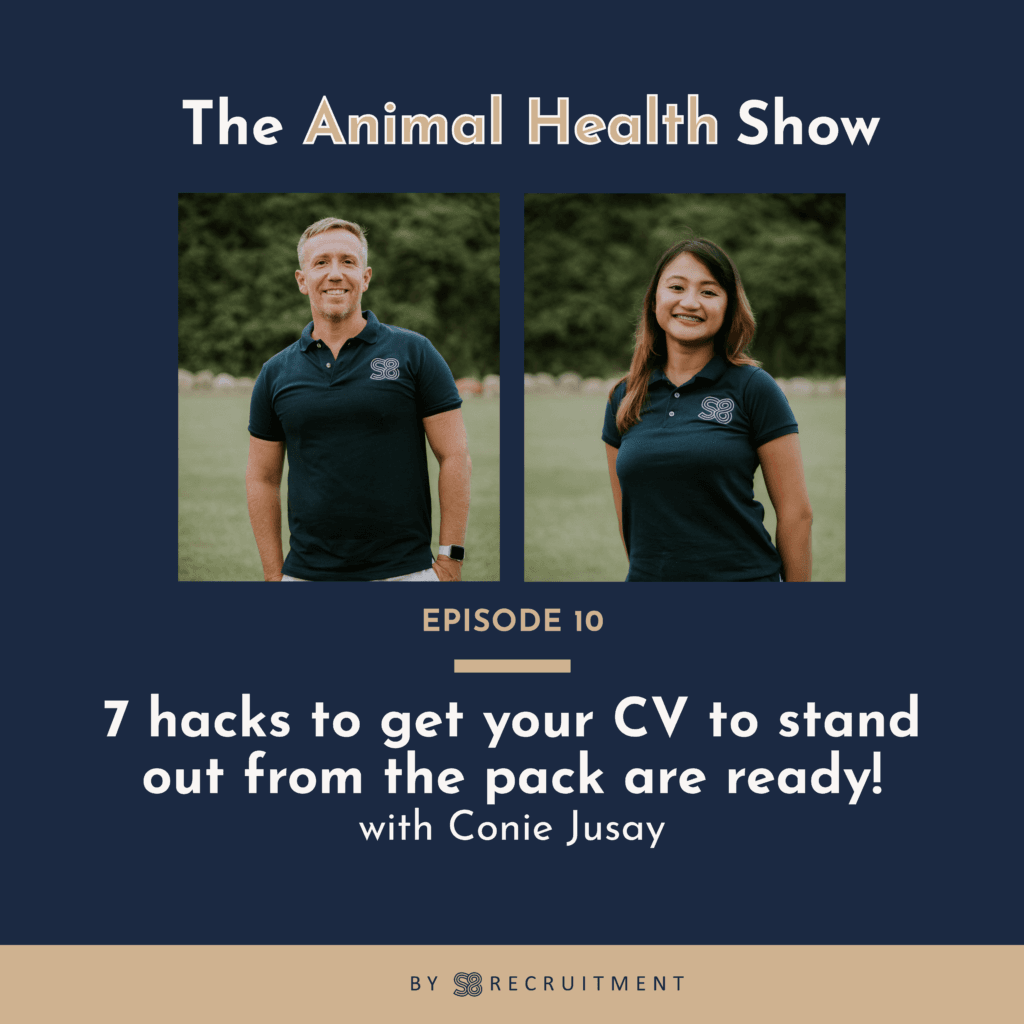
7 hacks to get your CV to stand out from the pack are ready!
What does it take to succeed in animal health?
Industry veteran Richard Romano joins Shannon Wood to share career lessons, leadership insights, and his views on the future of animal health, ag tech, and industry innovation.
SHOW NOTES
TRANSCRIPT
* Transcript created by AI – may contain errors or omissions from original podcast audio
Welcome back to The Animal Health Show, and today I have a very exciting guest. She works alongside of me. She’s been working with me for nearly two years, so in August it’ll be two years. And I wanna introduce to you, you’ve probably seen her CV, LinkedIn profile everywhere, but this is Conie Jusay that works next to me.
Welcome to The Animal Health Show by S8. I’m your host, Shannon Wood, and this is where we talk about the latest trends shaping the animal health industry. We’ll be sitting down with leading voices from across the sector, sharing practical insights to help you grow your animal health business, build a stronger team, or land your dream role.
If you’re looking for your next dream job or you’re ready to hire your next standout team member, reach out to us at S8 Expert Recruitment Solutions. You’ll find our contact details in the show notes for today’s episode. All right, let’s talk animal health
How are you, Con? Hi, Shannon. Hi, everyone. Welcome. I’m good. I’m pretty excited. Yeah, me too. Today we’re gonna talk about seven hacks to get your CV to stand out from the pack. I’m sure over the last two years, I know you’ve seen over, I don’t know, probably hundreds if not thousands of CVs.
And by now you would’ve seen, like me, over the past 20 years, some of these things that might just help candidates who are listening to this to get their CVs to stand out. Let’s rip into it. I’m gonna kick things off and, when I’m sorting through CVs and I guess this is one of my maybe pet peeves or one thing at the moment I would definitely not put on is a photo.
Most photos, I don’t know if you can agree, but most photos that we look at might be cut out from a birthday party or, you might see a strange arm over it or, it’s not a clean professional headshot. I’d say maybe, what, one in 1,000 or one in 100 that might look all right. But as a general rule of thumb, I would definitely say not to put a photo in there.
It just looks a bit, I don’t know strange. But, definitely have one maybe in your LinkedIn and have a good photo on your LinkedIn, have a link that goes back onto your LinkedIn profile that can that can get them there to see what you look like. But yeah, on a CV, I would just keep it nice and plain and simple.
What’s your thoughts? Yeah, I actually agreed with that. I’ve received a lot of CVs with cropped photos. Yeah And for example, just like in a wedding, and then you can see at the side that there’s an arm on- yeah … below. Yeah. And it’s really bothering. It could create a negative impression.
I’ve always thought that, don’t know how to say it. This is first impression lasts like that. Yeah. I think you’re right. A photo does definitely leave a lasting impression and and if it’s a really nice, good photo, it does help elevate, but if it’s a poor photo- Yeah
it does the complete opposite. Yeah, I definitely agree. And then I’ve also received a selfie photo. Like- Yeah … and then the angle was like y- it’s the eyes is staring at the top and then- Yeah … supposed to be… It would be better if they’re gonna take it in a professional headshot.
Yeah. That would create a great impression for recruiters. But if you don’t have one, I suggest you just paste a link on or a QR code. I’ve noticed those very innovative candidates that they put QR codes- Yeah … in their CV. And yeah, if you don’t know how, you can just paste your your LinkedIn link, and then it will be easy for us to scan, and we can see your photo, your background.
This is not about the photo related, but since we’re speaking about LinkedIn, it would also be better if your CV and your LinkedIn aligns. Okay. Yeah. 100%. Yeah. Oh my God, that’s a, maybe that’s a whole new podcast episode because having- … The dates and companies and all that aligned, it’s I think there’s that initial impression. And also on that with photos on LinkedIn, make sure they’re current because there’s nothing worse than having a look at someone’s photo on LinkedIn and then you see them on Teams or on Zoom or in person and they look nothing like that photo. You feel like you’re being catfished.
Or the first impression from me and clients feel like they’re being lied to, and you don’t want that to be your first impression. So look, if you’ve got that photo from 20 years ago, you might have looked good- Better updated. Yep. If you’ve had super long hair and now you’ve shaved your head, update it.
Whatever it is, have a current photo that looks much more like you on LinkedIn that so you don’t get that first impression as well. And to what you were saying also, Con is 100%. Have… Make sure they’re all aligned and everything’s matching. ‘Cause again, it’s that same thing that people feel like you’re being dishonest or it’s not, it raises questions that- Yeah … that don’t need to be potentially asked. But so yeah, make sure that’s very important. Yeah. That’s true. Imagine we’re processing, for example, we’ve tried receiving, like in for one role, I received like 700-plus candidates. Yeah. And yeah, I don’t have the l- luxury of time to process everything.
And then we have to screen and interview, like that. If their information is updated, like their account the LinkedIn account and also their CV, it will be easier for us to scan. We don’t have to ask them a lot of questions and we can process the the application immediately on time.
So they’ll have the job as soon as possible. At the same time, we close the deal with our client. That’s it. Great. Take one, ditch the photo essentially. Now- And we’re talking a lot of stuff. Okay. Con, what would be your number one tip? For me personally
It’s okay not to put a photo as long as you put your LinkedIn profile. The link of your LinkedIn profile so that we can have also a reference just in case, what if another person will show up in the Teams interview? Yeah. So yeah. And yeah, it’s not necessary that you have to put photo, but if you really want to you can put a professional headshot- Yeah
on the CV. Yeah. All right. So that’s number one. What’s… O- out of seven tips, so what’s your number one tip?
For me it’s, You should put achievements over duties. Yeah. In your CV- Love that … y- it would be better if, like… ‘Cause we’ve received a lot of applications, and there’s always this responsibilities stated. Yeah. And we know that a sales rep sells vet nurse does patient care, and practice managers manages the clinic, but what makes you stand out as a candidate?
So imagine there’s a lot of talents in the pool, and then you have to make an edge. So at a first glance in your CV, I would love to see candidates who have professional summary on their CV ’cause it shows or it summarizes, we know what to expect at the, like- … second page or the third page, and how did their career grew and what’s the positive ex- contribute, that they could contribute in the role that we’re looking for.
So- I think even as an owner and I’m sure other managers are looking to hire when they see like, all those lists of achievements, whether it’s like Sales Rep of the Year they’re seeing, yeah, grew this territory by 20, 30, 40, 50%, whatever it is might have even gone from, we grew it from 1 million to 10 million over the last three years.
Real tangible things that s- sales managers or other managers might be reading going, “My staff aren’t doing that. Wow this person sounds amazing, I want to have a chat to them,” ’cause they can see real-life achievements that, that they’ve done and they’ve succeeded in and it just, I think it sells them in a lot more than just trying to list off bunches of duties and responsibilities.
Yeah I love that. I love that. And what about anything else in terms of, – one of the third ones I was thinking of is similar to that with some of those achievements because is having the proper jargon in terms of, these days we’re talking when people are relating to a certain industry, might be the veterinary industry, we all use jargon words.
We, … And the more- Yeah … you’re in them. W- when I started working for Nestle Purina doing recruitment for them years ago they are the king of acronyms. Honestly, I’ve never worked with a company that, that has more acronyms in those businesses. And you work- looking through a PD, I had to ask someone to spell it out to me because there’s so many acronyms in there.
But these are the things that, people relate to and feels like you’re in, in that industry. If, even if you’re not, I would try and tweak my CV to use certain keywords. It’s really obvious if they’re from a different industry and they’re using different industry jargon or phrases that
And when they’re trying to go for that role, even though it might mean exactly the same thing I just think those little minor tweaks can really help elevate their CV to stand out as… Have you got any other examples or- yeah. It this is definitely true. ’cause like before I started working with the s8, I never had any idea about the key, those technical terms in the industry.
But then later when I l- pro- met and processed a lot of candidates and then I have new roles looking for companion animal, livestock, ruminant, like the- Yeah … ovine, bovine, those terms. Yeah. It would be easier for me if I’ll, oh, if this specific company is looking for ruminant nutritionist.
So one thing the basic step that I’ll be doing is that I’ll scan the profile and then find the keyword if ruminant is present. Yeah. So yeah it helps the recruiters to pro- so we don’t have to dig dep- deeper like a detective and then find out that, oh, he had ruminant experience.
He has livestock. So it should be, like, shown in the CV. Yeah, definitely. If it had, even if it just had nutritionist, you’d be like, is that a human sort of- Yeah, true, yeah … Nutritionist? Is it a aqua monogastric? Yeah. Or whatever sort of nutritionist. And if it comes up just nutritionist, it might not come up and which I think that sort of leads us on to our another, the fifth one that sort of makes sure, what we’d like to do is keep it clean and scannable.
These days a lot of companies like us, we have an ATS system and we’re we’ve got 30,000 plus CVs on our database, and we’re trying to do a search, trying to find a candidate that might have applied to a role, we just can’t remember their name for some reason. Then we’re trying to find a bunch of, let’s call it ruminant nutritionists- Yeah
that you were putting. When we’re doing those searches it makes it scannable for us, so it makes it pop up. And we can contact the right people. And then when we’re maybe sending messages out to ruminant nutritionists, they’re going to just ruminant nutritionists not the wrong people as well.
So we’re trying to really make sure that data’s correct. But also on the next stage is there’s the AI as well that, these days that if your CV isn’t scannable or parsed properly from CV to the database it’s not gonna be picked up. And that means that you might just go straight into the rejection bin before it even lands into the long list or to a short list.
And you might have those skills. So that sort of, that jargon that, that wording overall is gonna keep it really succinct for ATS scannability, AI. Make sure you don’t get lost or rejected in those, in that pile as well. Have you- Got any other comments on that?
So in addition to that scannable, it should also be like we- candidate should also keep it clean. Yeah. ‘Cause, yeah, a- and there’s a lot of CVs like they have very colorful profiles. Yeah. And then some uses v- neon colors. And then one should make sure that their fonts, the color of the fonts that they’re using should be readable.
And then also, it’s not too bright. The minimal the better. And- Yeah … yeah, ’cause there … I know there’s a lot of AI tools that we candidates use so that it will be easier for them to create the CV. But plain is enough ’cause it’s more readable. It’s easy to scan. The text won’t be like, yeah, it won’t be hard for us to find those details that we’re looking for.
There’s also some uses graphs and they have formats that … Sometimes the details will be, like, overlooked by the recruiters. Yeah. So even better we can just follow the basic, then yeah. That’s already good enough. 100%.
And sometimes when it’s They look amazing and it’s normally the marketing people that are very creative that we get these fantastic whiz-bang looking CVs. But they’re really difficult to try and search through or they might not come up in our searches. But I remember a few of them and they’re like, how come they not come up?
And maybe their experience is in a different box and or it’s just, it’s a picture and, Oh, yeah, the picture. Yeah, of where they work. Or a company, like a sort of a logo of where they worked and all that sort of stuff. And it’s kinda… They do look good, but sometimes just that, that, that scanability, that, that clean look sometimes really is just gonna be, is better ov- I agree
overall. Yeah. Yeah. I also have this a candidate that they use multiple fonts on the- Yeah … on the CV. Yeah. And the other one is cursive and then the other one is A Times New Roman font. And then, and Not good … th- the upper part is they… It’s a soft summary but then in the lower parts they use smaller fonts and it’s too small.
Yeah. So we have to zoom in the details so that we can understand it. So it’s pretty rough on the recruiter’s end. Yeah. It doesn’t look good, does it? And oh, it’s… The other one, just it’s probably not a big one but, with that is having the newest role at the top and their oldest positions down the bottom.
Where sometimes you get a CV and you’re like, “What?” you’re looking at stuff that’s not relevant and it’s not till you scan all the way down the bottom and you’re like, “Oh, you are a veterinary pharmaceutical sales rep that I’m looking for in Sydney.” But, all this other experience you’re rolling through.
If I didn’t go all the way to the bottom, I might have just binned you because I’m just trying to scan over, tick, yep, all right, you’re worth a call. When you’re working through hundreds of CVs. Yeah, that’s true.
The sixth one, it’s the detect start showcase. These days employers want someone who is like knowledgeable and who has experience with the softwares and platforms that the employers are using. Yeah. Yeah, it would be better if the candidate would highlight those tools or like those experiences that they had.
Like for example, proficient in Salesforce, JobAdder- Yeah … and then include the ATS, or platforms that we are using. Oh. So that would create a good impact. ‘Cause like in one scan the recruiter would say, “Oh, this is the client.
This is what we’re looking for.” Yeah. So yeah. He’s like familiar with spreadsheets- Yeah … Excel,
yeah those things. It’s really like helpful. Yeah, big time. And I think I was at the vet conference the other day and people asked me, “Do you ask vets these days what AI programs they’re using?” ‘Cause there’s a lot of AI note takers. And they’re really leaning into those sorts of programs and…
‘Cause they’re like, before, like maybe six months ago, that question wasn’t asked in an interview before. And I was like, yeah it’s happening. Even with nutritionists, so doing balancing formulations and ration diets they won’t… They need to know specific programs that work with…
Ideally they have some idea with some of these programs so they’re not having to do this massive onboarding process of their nutrition system to, yeah, right down to the, good old Microsoft or whatever you’re comfortable with. But yeah, some of those the sort of tech stack showcase as we’re calling it is definitely something if you’ve got it you might as well add it and put it there.
Especially for us, if we’re scanning through again and we see, oh great, the client did mention that, if they’ve got this specific program that they’ve got experience with, that’d really help them stand out on the pack or put them on top of the pile, so to speak for when we’re looking at some of these CVs.
Yeah. Agree and I think on that sort of scan-ability we’re looking at above the fold or the hook is ’cause, as recruiters is we’ve, or we, I think we’ve said it three or four times now . Recruiters scan through CVs. If I come in on a Monday and I’ve s- put up a, an ad and you’ve got, 300 CVs you gotta get through and you wanna have a look at every single one of them.
Personally, I don’t want someone else or a, sort of an AI doing that for me. And so we’re just going through, sheer number of CVs. And, getting those kind of candidates that can really grab our attention within, a few sentences their best selling points rather than, burying their sort of best traits sort of two page down.
You want to have everything right up the top, right at the beginning what makes them suitable for that job that they’re applying for. And it could be, it could be experience. It c- that’s relative. Anything. If you’re going for a, I don’t know, sales role, vet sales role or nutrition role that’s in, in sales, for example, you wanna highlight your experience and really showcase that right from the beginning not all the way down the very bottom again.
Have you got any other examples where you might have seen something like this that works or doesn’t work? Yeah, ’cause some just put professional summaries on their, … CV at the top, like below their name which is really good ’cause at least we already know what to expect a- about that candidate.
And then “Oh, this candidate is really good, so like we’ll pass him in the screening round.” But there’s also these candidates who doesn’t have they have very long career experience, but then, yeah, it, it doesn’t show at the top. And- Yeah … It’s kinda it’s not necessarily like very negative, but it does create a negative impression to us recruiters.
And s- yeah, so I suggest that one should put something like a professional summary at the top of their CV. Yeah. Yeah. Yeah. Good, good. One more that I really wanted to add into our list today, and this one’s a biggie for me is own your career gaps. Like- Candidates who don’t put, say, dates in there, it looks suspicious.
It really does. It asks questions, and I’m sorry for anyone that’s a bit more older than I am, which is pretty bloody old. It really looks like you’re trying to hide your age. And it doesn’t work by not putting the career things in there as well, like in terms of your dates from where you’ve worked and to and from.
Sometimes you’ve got gaps. Look, we all have had gaps and for whatever reason that is. It could be travel, it could be family leave, it could be, some really unfortunate sicknesses. But I think that, even if, I’ve had some horrific stories of, why people have had these gaps.
Like their their children have unfortunately passed and stuff like that and you get it. But I think what that transparency does is build immediate trust with anyone looking at their CV and potentially it doesn’t give them a negative, “Oh, they have– Why haven’t they been able to get a job for a year or 18 months?”
Or however long that, that issue or that, that thing came up for them. It’s you read it, you see it, and you’re like okay.” that’s- Yeah … you it’s already… You don’t need to ask the question. It’s already explained there. And to our point, when we send, we speak to a candidate.
Oh my God, they’re really good. We’ve gone through, we’ve checked why they haven’t, what they’ve been doing in between these dates and and they’re like, “Oh, yeah,” whatever it is, we traveled or went overseas. And then we send it to the client forgetting that we haven’t actually fixed up their CV and the client asks us the same question like, “Ah, looks like they haven’t been able to get a job for six months.”
You’re like, “Oh, no, they actually did this round the Australia trip caravan, once in a lifetime opportunity,” blah, blah, blah, whatever it was. And they’re like, people get that. But I think again, if you have that in there it, it doesn’t put a question mark around. It’s just that transparency just builds that trust straight away.
Yeah. It’s much better to be up, upfront and transparency is really important ’cause I’ve had a lot of candidates who have short stints and then like it would… If they work this specific company less than a year and then they move to another company and then take a long break.
So it’s quite very like fishy or kinda- or it’s kinda it’s a g- gen word, like- … sus. Yeah. Yeah. So it’s a very Gen Z word, like sus. Yeah … and then yeah, I was like, “What is doing?” And then, so it would be better if the explanation, even one line is enough just to justify your reason- Yeah
why you left that former company of yours, why you had a six-month break. Yeah. It will be easier also for us to understand. And also as a recruitment agency we forward your profile to our clients. So it will… I- if we already know that it is easier for us also to defend our candidates and explain it to the clients that this is the reason why our candidate is on break on this specific months.
And, yeah, and then espec- and especially if it can also… It will also be used as a verifier for us just to check if your reason during the interview aligned with what you put in your CV. Yeah, that’s it. Yep. And again, make sure those dates marry up with your LinkedIn profile as well.
Yeah. ’cause that doesn’t look great if you flick over to the LinkedIn and it’s all out of whack for whatever reason. Yeah, make sure they’re, make sure they’re succinct. So that’s seven great hacks just for your CV to stand out from the pack. But so number one, we had ditch the photo.
Again, h- make sure there’s a really good picture on LinkedIn. You don’t want one of those really old ones that you looked good 20, 30 years ago but looks nothing like you now. Just people feel trust. Again, I love that one about what yous mentioned, Khanh, about having achievements over sort of duties.
Really showcase and highlight why you stand out. Could be, again, sales rep of the year and, makes you jump off the page. Tailor the jargon yeah, that, that’s a good one. You can tell if someone’s sending that CV to multiple people and it’s the same one and for a different job.
Keep it scannable. Keep it nice and clean. I think we also mentioned the other one i- in terms of above the fold, at the top, grab someone’s attention, hook them in. We did the the showcase, the tech stack, so having any sort of programs, IT stuff that’s relevant for those roles or even if it’s not it’s makes you stand out I think above and beyond.
And make sure your career gaps own them proactively. Be transparent whatever that is. But just have it in there and I think it’s just gonna build trust and right from the get-go Con Yeah … I really appreciate your insights for everyone.
Thanks for diving in and jumping in on here. I think it was last minute, but, … look, you’ve done so well, I might even get you on another one very shortly. I’m sure everyone out there would like to hear a little bit more from you and not just from me. So look, thank you for coming on. Thanks for your insights, and keep bringing that Gen Z vibes with you.
And look, thanks everyone for listening, and look forward to catching up soon. It’s a pleasure. Thank you everyone.
Thanks so much for tuning in to today’s episode of The Animal Health Show by S8. If you found the value in this conversation, please share it with your colleague, an industry mate, or on social media, so we can keep the discussions moving across the sector. If you’d like to get in touch, all of our details are in the show notes for today’s episode.
I thank you for listening, and I look forward to chatting with you again in the fortnight
* Transcript created by AI – may contain errors or omissions from original podcast audio