


Why “culture first” wins
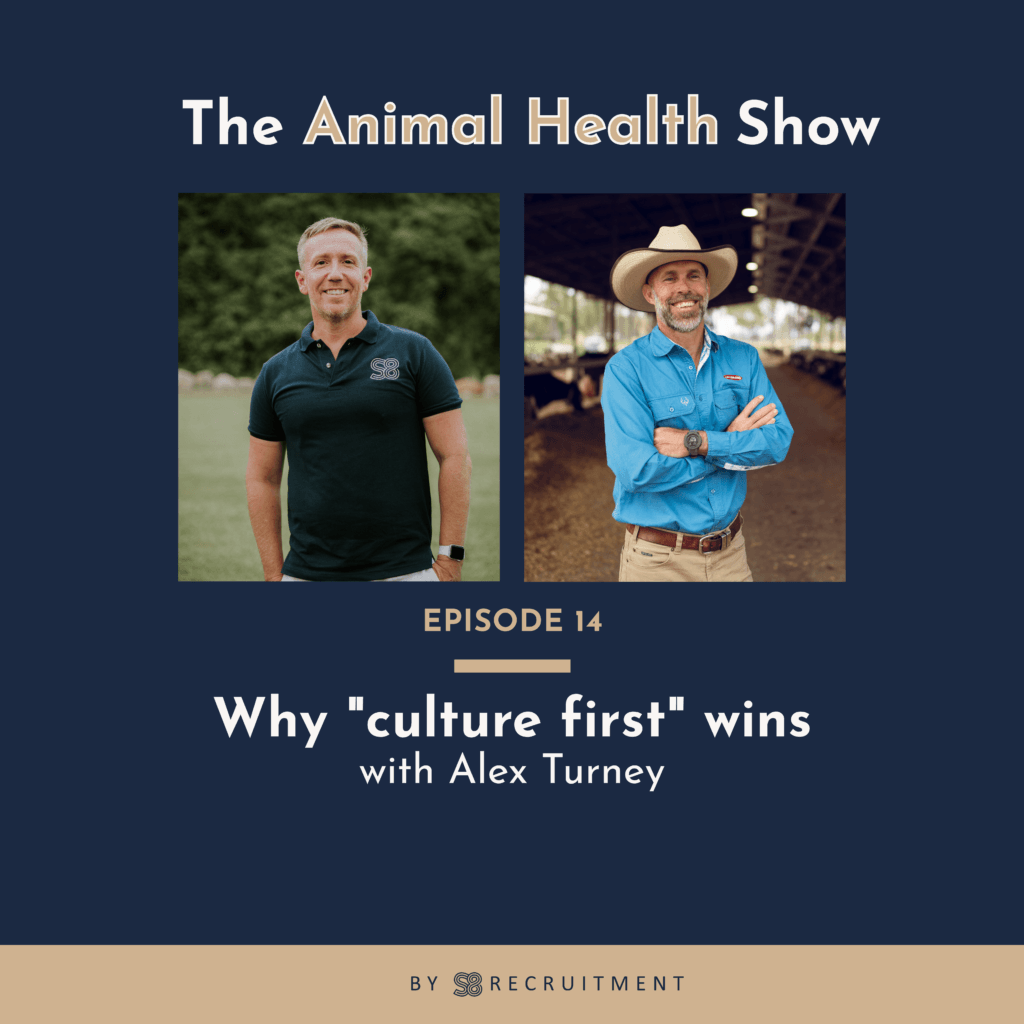
What does the future of animal health and ag nutrition look like?
Shannon Wood chats with Alex Turney of Lallemand Nutrition about leadership, culture, AI, precision agriculture, and the future of the industry, from building great teams to developing future-proof talent.
SHOW NOTES
TRANSCRIPT
* Transcript created by AI – may contain errors or omissions from original podcast audio
Shannon Wood: Welcome back to the Animal Health Show today, by S8. We’re diving into leadership, company culture, and the evolution of global ag nutrition with someone who’s seen this industry from every angle.
My guest today is Alex Turney, managing director at Lallemand Nutrition. Alex has kicked off his journey with a Bachelor of Applied Science in 1996, before building an impressive track record across global heavyweights in the feed and additive premix space, including some with Adiseo, over four years as business manager at Elanco.
And then for 15 years, Alex has been at the helm of Lallemand here locally, while also spending the last decade lending a guiding hand as an executive director across New Zealand, South Africa, and Indonesia, on top of running a massive regional footprint from the Sunshine Coast. He sits at peak body industries, including the board of the FIAAA.
He’s someone who’s not only grown a business from four to 20 people while fiercely protecting its culture, but someone who lives and breathes the future of our industry.
Welcome to The Animal Health Show by S8. I’m your host, Shannon Wood, and this is where we talk about the latest trends shaping the animal health industry. We’ll be sitting down with leading voices from across the sector, sharing practical insights to help you grow your animal health business, build a stronger team, or land your dream role.
If you’re looking for your next dream job, or you’re ready to hire your next standout team member, reach out to us at S8 Expert Recruitment Solutions. You’ll find our contact details in the show notes for today’s episode. All right, let’s talk animal health
Alex, welcome to the show.
Alex Turney: Thank you, Shannon. Appreciate your time, and thanks for having me here.
Shannon Wood: And look, before we unpack the business, I have to talk about the location of Lallemand Animal Nutrition-
local headquarters, are based right up there on the Sunshine Coast. In our industry, I suppose running a business with massive regional oversight and coastal paradise is rare as hen’s teeth. Now- When setting this up or expanding the base from the Sunny Coast, is this something of your doing or was it already locked in?
Because it feels like it’s ticked every single box when it comes to lifestyle and location.
Alex Turney: Yeah. I’m I’m one of the lucky ones, that’s for sure. I’d like to think that it was something of my doing, but it wasn’t.
Shannon Wood: Yeah.
Alex Turney: When Lallemand inherited or acquired the business of Quality Silage Systems some 20 years ago we were fortunate enough to already have a- an office here in Maroochydore.
Yeah … and the s- then the backstory to that is when the founders of that organization set the business up, they basically said to each other as a husband and wife team, Ken and Trudy said, “Where do we wanna live?” and they decided that the Sunshine Coast was the place.
Shannon Wood: Yeah.
Alex Turney: And with the amount of domestic travel that Ken was doing at the time, he said it doesn’t really matter where I am, doesn’t where my staff are because I’m gonna spend so much time on the road.
So in the weekend I’d like to live on the Sunshine Coast.” So we’ve been benefactors of that decision for some 20 years now.
Shannon Wood: That’s amazing. That’s amazing. There’ll be a, a, a bunch of people out there that are very jealous of your situation, but,
Alex Turney: Yeah … do you want to give- And I guess to frame it up though, when you have a customer service, ops, finance, marketing do they really need to be located in a rural town or somewhere in a big city?
And the short answer to that is no. I think for me, as long as they are connected to each other and we’ve got a nice office environment here it’s super productive and people are engaged in what they do.
Shannon Wood: Yeah. Yeah. I could imagine they would be if they’ve got that- … that balance.
Alex Turney: Yeah, and it’s just gone offshore we might even get a surf in before dark.
Shannon Wood: Very good. Yeah, the sun has turned. But I know w- the thing about Lallemand i- is like in the industry, everyone knows Lallemand, right? They know it in some of the ag industry. But I think until I had a good conversation with you, you’d dove into turned up to a- an event one day, and there’s bottles of champagne and there’s bottles of, Yeah
scotch there. And there’s a lot more to just Lallemand beyond animal nutrition. Are there any other sort of surprising global divisions or, that consumers or that we don’t know of about Lallemand?
Alex Turney: Yeah, absolutely. It’s a global private, enterprise owned by the Shan Yong family. And it’s wonderfully diverse, and you touched on a few of them.
Obviously there’s distilled spirits and bioethanol. Yeah. And so that’s there’s 1BU. We have enology or wine-making. So our interest in champagne is because Lallemand owns the Institute of Champagne.
Shannon Wood: Oh.
Alex Turney: And then there’s all many others. Plant care, bio ingredients. So food, food ingredients things.
We’ve got a human health division, pharmaceuticals, but it’s only very small. We’ve got a coffee division when we think of, Okay … enzymes and breaking down that coffee process. Yeah. And of course we have animal nutrition. So there’s a, it’s an extremely diverse business which does really have its benefits when you have the swings in different markets and economies around the world.
Shannon Wood: Yeah. Yeah. And but and if we zoom straight into the ANZ market most people associate you with sort of online farm and running a mu- but you guys are running a much broader business even locally, right? With, … Silage the sort of, yeah, the enzymes. Then there’s the other interests within sort of the tech that you guys are doing as well.
Alex Turney: Yeah, we’ve probably got three parts to the business. The, the, the legacy component of our business is is our silage, quality silage systems work. Yep. Helping clients with their silage outcomes and that encompasses a, a silage consumables and reusables framework.
Shannon Wood: Yep.
Alex Turney: The second part is our yeast and bacteria offering, so feed ingredients and additives. Which is hence my my passion for the Feed Ingredient Additive Association in Australia. And then the third component is is what we do with it’s kind of wearable technology, but it’s in that dairy industry of a rumen bolus with Smaxtec rumen bolus tech.
Yeah, it’s three quite diverse, but also very intertwined when you are driving up the farm gate.
Shannon Wood: Yeah. Yeah, it’s yeah it’s a very interesting sort of business, that Smaxtec. Everything I’ve been reading about it’s yeah is very cool. Yeah. I love all that sort of ag tech stuff that that, Excellent
happening. It’s evolving. No, it’s pretty cool. One of the as I mentioned at the start, one of the big things I wanted to get you on and talk about is the cultural sort of blueprint and, … A- about you and from, where I’ve sit, I’ve gone to industry conferences as a man and look, and candidates that I speak to these guys see people at Lallemand and they’re like, they, there’s an incredible team there.
They the feedback from you guys is that, you gel everyone’s having a good time. From a leadership perspectives, how do you deliberately go about creating that, we’ve got each other’s back sort of ecosystem within Lallemand?
Alex Turney: Yeah, that’s a, that’s an interesting question and there’s probably so many different ways that you can you can attack it.
And it’s certainly not about me. I was very fortunate. I inherited a core group of individuals that Ken and Trudy put together, and I think it starts at that core piece, and for 15 years we’ve evolved that. We’ve added to it and tried to keep that nucleus of culture, which is a real can-do attitude.
Make it a sport, have some fun with it. We’re here for for big chunks of our lives let’s enjoy each other’s company and enjoy what we do. And I think that’s a big part of it. The team genuinely actually enjoy what we do, where we play in the industry- Yeah
and and enjoy the interactions with our clients.
Shannon Wood: Yeah. That’s nice. I like that. ’cause, I don’t know, culture is something almost every company claims to care about and- Yeah … candidates heavily prioritize it. Especially when it comes to, I don’t know, long-term retention and stability. In your opinion, do you…
Is there a thing where you think most companies go wrong or when trying to build culture or- Oh, that’s a, that’s an interesting one. I think culture comes from within, right? You can’t force it upon someone. Yeah. You can’t tell someone about your culture. They have to experience it for themselves. And and I think we try and make part of the recruitment process a two-way conversation.
Yep.
Alex Turney: I think too often it’s one way. You find some candidates they want to… You’re interviewing them, but they don’t really give them an, a chance to interview you- Yeah … to make sure there is a good cultural connection. Yeah. Slow burn. Keep it transparent. And be curious. And certainly give everyone a fair crack at it.
Shannon Wood: And so from another, I don’t know, MD business owner listening that want improve their workplace culture tomorrow, are there, would there be one or two practical non-negotiable principles that you’ve implemented that- … you’d actually have to work to keep people engaged for long term? I
Alex Turney: think you’ve got to have a series of time-fenced visions.
So have a compelling vision for the future. Know where people are going to go. Where is this bus headed? And people have got to resonate with that, and they’ve got to connect with it. But equally to that, you also need to back away from a 5 or 10-year vision and give it to more digestible chunks.
So let’s have a one to two-year plan, or have a business plan for this year. Yeah. What everyone thinks and and joins the dots on those timeframes. Some people just want to know they’ve got a job tomorrow. Yeah. And what is my job? And others actually feel more comfortable when they know that this business is gonna be here in 5 years or 10 years’ time.
Yeah. So having a compelling vision across those time fences is a not negotiable. People need to know where the bus is heading. That’s a key. And I think if you then can recruit to fill that vision you can make every success of it. The other thing I think I’ve learnt is if you’re gonna fail fast.
Shannon Wood: Yeah.
Alex Turney: If someone’s not gonna be part of the team and it’s not working, sit with them, have the conversation. And nine times out of 10 they’ll realize they’re not a good fit and and you have that conversation. But make it happen.
Shannon Wood: Yeah. Yep. Yep. Nodding. I think I’ve had that in my own business as well, but yes.
Alex Turney: Yeah, absolutely.
Shannon Wood: Yeah. Now, you mentioned before the word slow burn and I was thinking about this. In, in a world that’s obsessed with hyper-growth you’ve grown a local business from 4 to 20, which is big, but over 15 years. That, was that a deliberate sort of steady burn? And is why is- the slow and careful scaling being essential to protecting that sort of team dynamic?
Alex Turney: That’s an interesting insight. I think it depends on expectation. I think there’d be part of me saying “This has been a slow burn.” and then there’s another part of me that says, “Holy shit, how did we get here?”
Having the responsibility to feed four families as opposed to 20 is a different landscape. Yeah … and I can only imagine what it’s like for, directors and CEOs of organizations that are in that, tens of thousands of people. It’s a slow burn in my world because we’re just incrementally building and putting people on.
And so that gives us the time and the opportunity to get the right people.
Shannon Wood: Yep.
Alex Turney: And have the right conversations and get the people to fit the business. So there’s both that technical element, there’s a cultural element, there’s a, a work ethic and a background and a storyboard that that has to match.
It’s always difficult when you’re trying to put a square peg in a round hole. Yeah. Just doesn’t work. As I said before, I think if you can make recruitment processes a two-way conversation and giving exposure to new people that you’re trying to recruit, give them a window into your business.
Let, let them come and see and meet more of the people-
Shannon Wood: Okay …
Alex Turney: so that it’s not a one or two touch point interview process, ’cause I think that’s dangerous.
Shannon Wood: Yeah.
Alex Turney: It’s dangerous for the employee and the employer
Shannon Wood: Does that obviously you’ve cracked it here in Australia. And but when you’re looking at overseas markets is it the same sort of principle in, in, in having more touch points with other staff?
Alex Turney: I think we’re quite, we’re a bit of a unicorn with our recruitment process here in Australia.
Shannon Wood: Yeah, okay.
Alex Turney: I think and all those countries are so different. You know- Yes … New Zealand is different to Australia it’s different to Indonesia for sure. Even the South Africans. And then if you look into Asia, it’s different again.
Multi diversity cultures it’s a real melting pot when you get into some of those other places. So yeah, I think what we try and do is expose our team locally to some of those other cultures. It does two things. It exposes them to the experience of these other places, and it lets them then know what’s the relativity to what you’ve got back here on this side of the fence.
And so I think they appreciate the sort of the dual insight, and it allows the other businesses too to see what sort of people we’ve got. Yeah. How they turn up to these regional sales meetings or more global events and share some of that culture and passion and commitment and and and insight that we’ve got to the business.
Shannon Wood: Yeah, I love that. I like that. I could see that as a recruitment process from a candidate’s side anyways it having, knowing all of that information when they’re speaking to your team, saying, “Yeah, look, we’ve had touch points with other parts- … of our company globally and or regionally, locally.
And yeah, this, we’re all, can talk about each other and feel a bit more connected and, yeah, just have that-
Alex Turney: Absolutely.
Shannon Wood: Yeah.
Alex Turney: And you and I have had some great conversations over the years around, around some of these topics in question, why do you do this?
Why do you do that? And and you and I have had some great long debates around what’s right and what’s not right. Yeah … I don’t think I’ve got the right answer to all the questions, but it’s certainly a process that’s worked for us.
Shannon Wood: Yeah. And we’re doing something right anyway, whether you know it or not.
Alex Turney: Here’s hoping. Depends who you talk to, Shannon.
Shannon Wood: I was gonna look at looking back f- over the past 20 plus years in sort of animal health, animal sort of nutrition the shift’s been massive. Has there been a single biggest advancement that you’ve seen fundamentally change in how we feed and care for livestock?
Alex Turney: I think this precision ag piece, it doesn’t matter whether you’re formulating diets or mixer wagons or the specific ingredients we’re using I think this attention to detail-
Shannon Wood: Yeah …
Alex Turney: Has just got greater and greater, and that’s part of that software, part of its ingredients, part of its time, part of its skill set.
Obviously science and knowledge, I think they’re the bits that really that really add the value. They’ve… When you think of diet formulation, feed enzymes, amino acids, protein kinetics, all of those things have really been a fundamental change to driving feed conversion ratios and just driving efficiencies in business, for sure.
Shannon Wood: Yeah, okay. ‘Cause ag nutrition used to be seen as quite, I don’t know, traditional, but today bioscience, microbiology and as you mentioned just then, precision farming. In, in your eyes, when did the industry pivot from standard feed to high-quality specialized biosolutions?
Alex Turney: I think it’s been a gradual burn.
Yeah. I think, but particularly in the last five years, as the markets have evolved, and if you go back now, it would’ve been 2016, I think we saw the r- those challenges on things like tylosin, and we’ve had this bubbling kind of issue with monensin. Some of the antibiotic usage we’ve had antimicrobial resistance.
I think the, the shift there and the pressure has probably led us down the path of things like more yeast, more bacteria, more of these biological fermentation agents to do some more lifting.
Shannon Wood: Yeah.
Alex Turney: We’re not gonna replace antibiotics, but those fermentation type products are really driving, the businesses forward.
Shannon Wood: Yeah.
Alex Turney: And I think our science and our understanding of modes of action, strain specificity a- and what we’re actually looking to get out just gets greater and greater. It gets higher and higher.
Shannon Wood: Yeah. Do you think AI’s having, gonna have a bit more of a, an impact coming up as well with just being able to have that much data and- Yeah.
Alex Turney: Yeah. It’s a fascinating space, AI, isn’t it? We only talked about it this morning with some colleagues. And I think there is this realization now within businesses-
Shannon Wood: Yeah …
Alex Turney: to ask how’s it gonna play out?
Shannon Wood: Yeah.
Alex Turney: Where are we gonna deploy it? How’s the productivity improvements gonna come, and what do they look like?
Is it less people or is it existing people doing more? And I think there’s a nervousness about where that comes. I think it’ll be a little bit of both.
Shannon Wood: Yeah.
Alex Turney: I think there’ll be growth and improvements in productivity where AI just plays a role.
Shannon Wood: Yeah.
Alex Turney: And I think there’ll be some replacement of tasks which may lead to, less people in organizations.
But I think as businesses grow, we’ll see… My gut feel is we’ll see a stagnation of the sort of people growth in an organization overlaid with AI deployment, productivity gains, and those things. Could be wrong. But at the end of the day too, I think- In agriculture, people are people. We sell on relationships and connections and having conversations and exploring the data what it means.
We get out there and we see it, smell it, kick it, touch it, taste it. Yeah. And and that’s real in agriculture. A- and I think when we look at R&D when we look at translating R&D into customer solutions-
Shannon Wood: Yeah …
Alex Turney: you have to make it clear, you’ve gotta make it concise, and you’ve gotta make it simple.
So there’s a huge people element there that will always be about the consumer’s getting, the customer, the farmers are getting, super well connected. They’re tapping into the technologies, which is fantastic, and then really it’s up to us now to match that-
Shannon Wood: Yeah …
Alex Turney: and and help them on their journey at the same time.
So yeah, I see AI as a really fascinating field that’s just gonna keep growing and, I think it’s only limited with almost what we’ve got between our ears.
Shannon Wood: Yeah. Someone said to me the other day as well that it, like to your point of this, the way it’s moving they don’t wanna be the f- they don’t wanna be the s- front of the queue, but they just wanna be a fast follower.
… but you don’t wanna get left behind. I like that term. Yeah. Yeah, I like that term. I think there’s always a nervousness, isn’t there? Yeah. Depending on your sort of managerial disposition. And I quite like the fast follower. If you take a lot of the things that are going on now around greenhouse gases, carbon the whole policy environment of that space, you think, “Man, I’m not really sure how that’s gonna play out.”
Yeah.
Alex Turney: Ultimately agriculture’s gonna becoming increasing net emitter of greenhouse gases, et cetera. Why? Because we’ve got a growing global population and we all need to eat.
Shannon Wood: Yep.
Alex Turney: So there’s a fundamental reality there. How does policy manage that? I think it’s gonna struggle ’cause it’s gonna actually have to say, “Okay, please just be more efficient.
Focus on efficiencies, water use, land use- Yeah … resource use,” rather than being a silver bullet driven, greenhouse gas reducer or methane reducer or carbon, less carbon into the atmosphere, et cetera. So yeah, we’ve got some fun times coming around some difficult conversations I think in that policy arena for agriculture.
Shannon Wood: I I was having a chuckle to myself the other day ’cause it was before we were coming on, but I remember you said that you had a bit of a… or someone said, “I think you’ve got a no problem, Alex, ’cause you’re on all these boards.” and the only one I could remember was that you’re on the FIAAAA, but I’m pretty sure it’s not the only one that, that you’ve been on.
What, what other sort of boards or committees are you currently serving or have you been involved with over the years to, Oh … help drive this sector?
Alex Turney: It’s not as many as you think, Shannon. Is it? There’s a few, the AMC conference with PICs.
Shannon Wood: Yep.
Alex Turney: There’s the program committee, just things like that.
Just giving back a little bit to the industry that you’ve been part of for nearly 30 years.
Shannon Wood: Yeah.
Alex Turney: I think it’s a, it’s an important part of the responsibility that we have as we age through our careers. We build brands-
Shannon Wood: You build brands
Alex Turney: Things.
Shannon Wood: Yeah.
Alex Turney: So we’ve got a, an opportunity to give a little bit b- back and that’s why the current, president role with the FIAAA, the Feed Ingredient Additive Association, is an opportunity to give back again.
Shannon Wood: Yep.
Alex Turney: I think the One Nutrition Australasia conference is a- Yeah … is another one. I’d like to see that really get ahead, and that’s been a passion of mine because we see so many conferences- Yeah … So many hands out for more cash, so many more demands on our time which is getting more precious. And so I think pulling together a number of these conference streams into one is really exciting. We’re gonna get better delegate value, better commercial value and some better outcomes for everybody. When we’re gonna have recent advances in animal nutrition the Australian Association of Ruminant Nutrition.
We’ve got the Australian Equine Science Symposium. We’ll have the Australian Association of Animal Science the FIAAA. We’ll have the Stock Feed Manufacturers Council. We’ve got the Australian Technical Millers all under one roof, so we’re gonna have this multi-species melting pot.
Shannon Wood: Wow.
Alex Turney: And I think that’ll really drive some unreal delegate value-
Shannon Wood: Yeah
Alex Turney: which will encourage good commercial investment and a rationalization of time and money for for a good number of people.
Shannon Wood: Yeah.
Alex Turney: So yeah, it’s it’s not too much. Couple of boards for Lallemand around the country with Indonesia and New Zealand-
Shannon Wood: Yeah …
Alex Turney: And our plant care business in in Albury.
But they’re just good fun, and they’re good learning experiences, to be fair. Okay. It’s a great way to learn and and observe other parts of the business that we’re involved with.
Shannon Wood: Yeah, ’cause I was thinking of, like, how do you go from sitting on the boards, it, it’s all about sort of macro policy, reg- sort of shifts, and, big-picture strategy, and then personally go from that sort of into, a Monday morning back in the office for a 20-person team, like locally, plus all your other stuff you’ve got going on around the region?
It’s… How do you sort of- Ah. How do you find switching gears like that all the time?
Alex Turney: I’d like to think that was really easy, but you’re right. It can be a bit of a nightmare. I think the key is just keeping it real. Keep… Always be prepared to get your hands dirty. So there’s always projects with staff individually in the field, in the office.
Keep connected to your customers. I love just chatting to customers. So when I’m driving, just ringing people. I think that brings you back into the reality of this is what’s going on day to day in the business. This is what’s going on operationally. And it keeps you connected to those around you.
So yeah keep it local keep the hands dirty. I love to sell stuff. I love connecting with customers and and working with farmers. So I think that keeps you grounded and it keeps you keeps you humble.
Shannon Wood: Yeah. ‘
Alex Turney: cause at the end of the day, that’s where the rubber hits the road, and that’s where both customer and and Lallemand derive value is making better agricultural outputs.
Shannon Wood: Yeah. Okay. Good. I’m still trying to juggle two things, and let alone family and all that. I like that, just keep it real. E- these, these industry associations obviously they exist to fight for the collective of the good of the sector, but would you say there’s one big challenge at the moment facing the feed additive industry right now that’s keeping people up at night?
Alex Turney: Yeah, I think there’s always that biosecurity and a food safety scare.
Shannon Wood: Yeah.
Alex Turney: I think those are the two things that we’re all gonna worry about. What’s gonna happen with something like a foot-and-mouth, or a lumpy skin, or an African swine fever, and now we have a bubbling avian influenza nudging on the doorsteps with bird flu.
Shannon Wood: Yeah.
Alex Turney: Those are the things that are a little bit worrying, for not just our businesses, but for the producers and the farmers. They’re gonna be economically impactful. And if it’s economically impactful of them, it’s gonna flow backwards to us as well. I think we’ve had a nice run for many years that we haven’t had negative press.
Yeah. Agriculture has been in a really good spot. We feed people.
Shannon Wood: Yeah.
Alex Turney: And I think it’s the most noble industry that there is on the planet, and and I’m super proud to be part of it. But yeah, biosecurity, feed safety-
Shannon Wood: Yeah …
Alex Turney: Those are the things that that probably keep me awake at night, particularly from a feed ingredient additive perspective or a stock feed perspective.
So- Yeah … yeah, that’s, that, they are the two challenges we have for sure.
Shannon Wood: That makes sense. And if you were to put, I don’t know, your crystal ball hat on what do you, what does Alex Turney think the next biggest thing in ag nutrition over the decade will be?
Alex Turney: The old crystal ball outlook. Yeah. I’m not much of a smart human, but for me-
I think we’ve just gotta keep focusing on FCA, being efficient.
Shannon Wood: Yep.
Alex Turney: It doesn’t matter whether it’s climate change stuff whether it’s water availability our limited land resources for different production sectors. We just have to keep being more efficient and better at what we do. That will drive good efficient policy directives.
It’ll drive better outcomes for farmers be it more profitable decisions. I’m not gonna say sustainability because I think it gets gets a bit greenwashed.
Shannon Wood: Yeah.
Alex Turney: But I think ef- efficiency across a farm business and in a supply business like ours if you can be efficient then you stay ahead of the game and put yourself in the best position to be profitable.
Which then means you can be more economically sustainable and you can then give back to the to the social fabric that you that you operate in. Keep the families fed and and keep doing the things that we need to do to give back to the industries we’re part of.
Shannon Wood: Yeah. Love. There you go.
Alex Turney: Easy … yeah. I wouldn’t be doing my job probably if I didn’t sprinkle in a bit of recruitment talk as well. But,
For sure …
Shannon Wood: L- looking at where the ag nutrition and microbiology are heading, I wanna talk about talent. From where I sit as a recruiter, candidates are always asking what skills actually make them future-proof, if you like.
If a graduate or a professional- … is looking to get hired by a company like Lallemand, what would you tell them to study or focus on? Or if it was one of your kids that wanted to get into it, is there a… Is it just- … standard ag science enough today? Do they need to be blending like data analytics microbiology, commercial acumen, or is there something else entirely?
Alex Turney: Yeah. This, this response might might come as a bit of a surprise.
Shannon Wood: Yeah.
Alex Turney: I would do something that just makes y- that you’re interested in. If you’re interested in ag, just do ag science. Yeah. If you’re interested in ag economics, do ag economics. You’re interested in microbiology, do microbiology.
Do something that makes your study easy. And the second part to that is manage your CV. Your CV is your storyboard.
Shannon Wood: Yeah.
Alex Turney: Your CV is your is your window into an employer’s mind, right? So you can get so much value out of telling a story on that thing there. Schooling, odd jobs, where have you worked, what experiences have you had.
The fact that you’ve had a higher education is a great thing. It shows capacity to learn. So then it’s not so much about the specificity, it’s about a capacity to learn and be curious and ask questions. I think for me it’s do something you are interested in ’cause that makes study easy. Manage your CV, and and then just, yeah, be prepared to do the hard yards.
I think getting caught up in the too specific world can be a little bit dangerous. Yeah. ‘Cause then your expectations can get too narrow, but you just never know where you’re gonna end up. Yeah. Okay. Yeah, ’cause I always get candidates I’m speaking to they, present really well, got some great numbers on the board in terms of, finishing ag science growing up rurally, and they’re like finished, and they’re like I want my…
Shannon Wood: I wanna start.” and trying to get them to start somewhere. They’re like I’ll do anything.” one of the things I say, maybe go and work in a, in an ag rural store if you want.
Alex Turney: Yeah.
Shannon Wood: Gives you good sort of networks. It gives you a, a, an understanding about lots and lots of different companies and their products and what they do.
And from there you might learn who’s good and who’s not and, Absolutely … but yeah, that was just, that’s just one, one small way. But yeah, I just thought there might be something else that might be out there as well that just to give these young young grads a, an opportunity to get noticed or recognized or, or-
Alex Turney: Absolutely.
So I think for me that CV is a great storyboard, but there’s three words that come to mind. Brand- Yeah … network, and your experiences.
Shannon Wood: Yeah.
Alex Turney: And those three things shout at you from a CV. Yeah. What is this character’s personal brand? What is this storyboard telling me? And then when you look through those experiences on a CV, they’re giving you the, an understanding of a network.
Of a value proposition to me as a potential employee. And then obviously the experiences. What have they done there to touch it, smell it, kick it, taste it? What’s what is their what’s their experiences telling me? So with those three things in mind, across the storyboard of a CV- you can get some wonderful insights into into people. And you’ve- F- You for one would see that every day.
Shannon Wood: Yeah.
Alex Turney: And see a CV and you think to yourself, “What’s this telling me about this individual?”
Shannon Wood: Definitely. Definitely. Yeah.
Alex Turney: And you and I have had some great conversations over the years, about candidates and you can get this gut feel. You’ll send something through, I’ll review it, and I’ll come back and you’ll go, “Yeah, I agree with you, Alex.”
Shannon Wood: Yeah. “
Alex Turney: That was a ripper,” or, “That one wasn’t so well-presented.” But it’s that storyboard brand network experience would be my would be my take-home.
Shannon Wood: Love that. Now, to wrap things up for all those younger grads or professionals coming up through the animal health ag industry, is what’s the most important soft skill or mindset they need to cultivate if they wanna thrive in this industry over the next 20 years?
Alex Turney: Be curious.
Shannon Wood: Yep.
Alex Turney: I’d really encourage curiosity, questions and effective listening skills. It sounds kinda crazy but if the more curious you can be, the better questions you will ask and and you’re gonna get a heap of information coming back from those questions. So then the ability to listen.
I think that for me is a beautiful loop of of three things; curiosity, questioning, and effective listening. They are the soft skills that will differentiate you moving forward in the workplace, I think, particularly with the next gen.
Shannon Wood: Perfect. Very
Alex Turney: good. Absolutely.
Shannon Wood: Thank you very much.
Alex Turney: Pleasure.
Thank you very much, Shannon, for having me today and sharing a few stories.
Shannon Wood: Yeah.
Alex Turney: Always good to catch up.
Shannon Wood: Definitely. Definitely.
Thanks so much for tuning in to today’s episode of The Animal Health Show by S8. If you found the value in this conversation, please share it with your colleague, an industry mate, or on social media so we can keep the discussions moving across the sector. If you’d like to get in touch, all of our details are in the show notes for today’s episode.
I thank you for listening, and I look forward to chatting with you again in the fortnight
* Transcript created by AI – may contain errors or omissions from original podcast audio