


Industry bodies vs. global corporates with Richard Romano
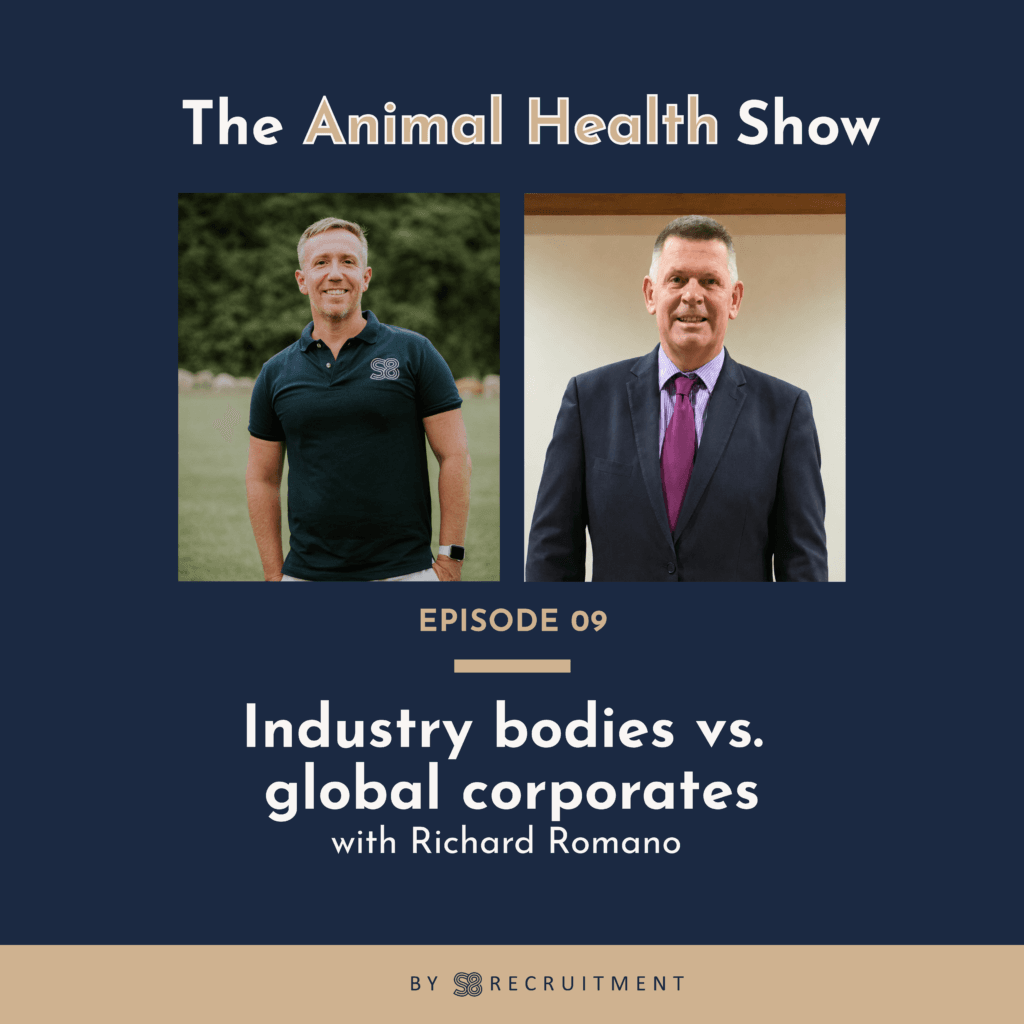
What does it take to succeed in animal health?
Industry veteran Richard Romano joins Shannon Wood to share career lessons, leadership insights, and his views on the future of animal health, ag tech, and industry innovation.
SHOW NOTES
TRANSCRIPT
* Transcript created by AI – may contain errors or omissions from original podcast audio
Today I’ve got a proper industry heavyweight here, Richard Romano a UQ ag science grad who’s basically a perpetual student of the game with masters from Massey and Melbourne.
I think there were some certificates I’ve seen down there within dairy. And then from the front lines as a, started off in DPI extension officer in Victoria, and then nearly a 17-year stint at Elanco, and then two and a half years at Dairy Australia, and most recently, a decade-long run at Virbac where you led livestock business unit.
Welcome to The Animal Health Show by S8. I’m your host, Shannon Wood, and this is where we talk about the latest trends shaping the animal health industry. We’ll be sitting down with leading voices from across the sector, sharing practical insights to help you grow your animal health business, build a stronger team, or land your dream role.
If you’re looking for your next dream job, or you’re ready to hire your next standout team member, reach out to us at S8 Expert Recruitment Solutions. You’ll find our contact details in the show notes for today’s episode. All right, let’s talk animal health
Richard, welcome to the show. Thank you very much, Shannon. Very great to be here with you. When I was looking into your background, I did see Massey in New Zealand. What was that like, or why did you end up going to Massey, out of curiosity? Yeah. Look I’d finished my undergraduate degree and I was in the middle of a big drought in Queensland, which is, not- that untypical, and wasn’t a lot of jobs around, and it came up an opportunity to do a a masters over at Massey, and it was a bonded scholarship. I got paid to go and study, which was really different to having spent four years as a poor undergraduate. Yeah. So I said, “Why not?” And I applied and was successful, and yeah, went over there to Massey.
And the idea of coming back with a job too was a really good part of it. So yeah, that, look, that was a fantastic experience and also a fantastic baptism to go and learn about the New Zealand dairy industry and then come back and work in the Australian dairy industry in Victoria.
Yeah. I hate the word, but I used assume that you did it remotely. I didn’t realize you went over there for the- No … for that time as well. Yeah. Went and lived there. Learnt that all the Aussie jokes that we have about Kiwis,
they have the same jokes about Aussies. So I had to bear the brunt of every joke for a while. Oh good. I won’t bring them up now. But and then, look, you’ve spent 17 years at Elanco and over nine at Virbac, both, big global corporate machines. Then- Yep … two and a half years at Dairy Australia, and I was like, one of the big things I wanted to get you in and have a bit of a chat about was, what’s some of the biggest hidden differences between, how things are actually done when you move from a KPI driven corporate world to a levy funded sort of industry body?
Yeah. Yeah, look so y- yeah, you asked me this earlier, that, w- what are those big differences? I think you’re spot on that you’re going from working with a business that’s in, in the corporate world you’ve got shareholders, to going to working for a levy paying corporation or, R&D company.
The… You’re very much going from you don’t see the shareholder, but you see the levy payers every day. So- Yeah … you get to see the farmers, you get to work alongside them. And that’s the big difference I found was, you could go and talk to them. You don’t get that with a shareholder, and the shareholder’s not as, I don’t think, as as close to what’s happening as what a, a levy payer would be who’s in the business.
And then, the… you talk about KPIs, you still have them. But they change. They go from having a sales budget or a, a, a brand budget that you’ve gotta hit to now having probably longer term, KPIs. You’re either setting up projects that are trying to make industry change over a, say, a five-year horizon, or you’re trying to execute, spending an R&D budget where you’re looking at projects that may be one or three or five years in length.
And you’re trying to, make that, make sure all those projects that you invest in occur and, and all… tick off all the boxes over that three-year, five-year time period that you invest in. So they’re different. They… I’d say- Yeah … that the levy organizations, generally you ha- are having a longer timeframe that you’re looking at, and that’s probably one of the key differences.
And then the levy payer is there. You’re working alongside them frequently. Yeah. I think you answered a little bit of this, but i- in pharma, your stakeholders, as you mentioned, are usually the shareholders a- and bosses Yeah … and in the industry body you’ve got, what, thousands of farmers and very loud opinions.
Yeah. How do you keep the peace while still trying to innovate products within the industries? Yeah, look I think getting t- getting out and meeting the farmers when you’re in a levy paying organization I think is a lot easier. Yeah. They welcome you on, they’ll chat to you, they’ll tell you about what works, what doesn’t work for them.
They’re very open. It’s probably harder when you’re working for a a big, corporate animal health company. You’ve only got, I suppose there, there might be 40,000, 50,000 farmers out there, but there might be only 5,000 who use your product. So it’s hard to find the ones who do use your product and then find them and have good discussions about what happens, where it’s far easier with the levy paying organization ’cause everyone’s paying the levy.
Some people don’t enjoy paying it, but they all want to, improve their o- operations. Some do it very well, others do it slowly. So in a levy pay, I’ve always found it a lot easier to get out there and have discussions with farmers about, what’s working, what’s not working for them.
And if you… Admittedly, you get 20 farmers into a room and you ask them to help you set priorities you probably get 20 different priorities. Yeah. So there is a bit of a skill in, in trying to, help funnel them all down into one or two or three things we could work on that could really make a difference for industry.
Okay. And like a lot of commercial reps think that industry bodies are where, I don’t know, careers go to get bogged down in red tape. Is that fair or is there like- … a commercial edge in those roles that people are missing? No. I think what happens you’re… ‘Cause you’re a lot closer to your board in the Australian R&D companies that yes you’ve got to get approvals to spend money and you’ve got to get the board and, your farmers to y- you know, you spend the money in the areas where are gonna make a difference for the industry.
So is that red tape? No, I think that’s just making sure you’re well aligned where you’re investing and where you’re doing projects and where the next round of development of extension activities come from. Is it more red tape? No, I think it’s just really good governance that they make sure that they, they get, they’re getting value for money out of that investment.
Yeah … Y- you’re spending, generally, it’s 50/50 generally in all the RDCs, the investment with levy payer funds and government funds. So the farmers really do take note of that you’re spending their money that they’ve earned. So I think that’s only responsible that you follow the governance that you’ve got to do to spend it.
It’s probably easier yet inside an, a big orga- animal health organization. You’ve generally got 12 months, targets going hit and so you’re coming up with plans then that you’re going to execute and run with. And generally there’s a smaller, chain. You’re not certainly going back to the board to say, “Can I…
Hey, can I… We do this type of promotion.” Yeah. It’s generally gonna be, a business unit director or, sit down with the company manager or something like that. All right. All right. In terms of some advice for, I don’t know, the next gen looking back at 1995 Richard- Yeah
with his brand new Massey’s Masters, Yeah … if you could whisper in his ear, is there anything you would’ve done differently in those first five years? Oh, no. Look, tell you what, I, first five years I think were the most fun I ever had. You learn a lot. You got out there and you tried a whole range of different things, and you can do that when you’re new and young and people will take you under their wing and, help you out and give you advice.
I just say learn as much as you can. Lap it up. Listen to those the, the older, wiser heads around you and see what you can learn from them because they’ve generally, seen it all. And the really old, wise heads that are worth listening to, geez, they can give you a lot of good advice to learn from.
Probably in those first five years is, yeah, keep listening- Yeah … to go find them, make sure you build that relationship with them where, they can really help you, in terms of your career by taking on board some of the things they share. Yeah, I know in recruitment, I’m certainly get asked this a lot and in terms of some grads going looking for jobs and I’m like, one of the things I’ve always said to them is maybe become a retail rat in one of the ag stores and- Yeah
Get to learn about a lot of different companies and products- Yeah … and get to really get their fingers in and build up some networks within their local region and, just get to understand that industry from a, a- Yeah … more of a commercial perspective than perhaps a, straight out of university with all the academic and, education expectations.
So yeah I just find that, yeah, with that this gives them a good little br- grounding. Yeah … but yeah, and I’ve seen people move from there into sort of commercial roles, but not so much from there, depending on, their degree and what’s looking, but for, more those industry bodies.
But, Yeah … Yeah. When you’ve h- hired a in, in the industry levies, is there anything apart from a tech background or science or things that, made people stand out in, in, in the industry? Oh, look I think having a connection to the industry’s always a high-value piece. Yeah. I know the people I worked with and were around me when I was in DA all had a really strong connection to, to dairy farming.
Having, I had a, worked in dairy extension for a lot, for three years. Had a master’s in dairy farm management. Others had come off dairy farms and again, worked in, maybe o- other industries that worked alongside dairy. So I think inside those companies it’s really important that people have that passion and an interest in dairy farming.
Maybe you’re in a, in the beef, MLA or there’s veggies or there’s, crop and others, a w- whole heap of different RDCs out there. But I think having that passion or interest really helps you go a long way, especially if you’ve got to sit down and talk with some levy payers.
It really does help you to have good discussions, deeper discussions with them. Yeah. Yep. And you moved from extension to sales marketing to general manager. Would you recommend graduates, I don’t know, pick a lane early or is that an ag science degree that will ultimate sort of ticket to being a generalist or look I, I think the ag degree opens up a whole avenue of opportunities for someone. It’s, it’s that base degree to show that you can learn. Yeah. And you can do a- anything basically with those ag science degrees. I think the… If you want to go further along, I think certainly getting some leadership skills.
N- I, in my first people management role I did a Cert IV in frontline management. I think that once you get down to that path that you want to go into people management, then I think you need something else. Yeah. Certainly some of my colleagues went on and did MBAs which, even more successful again to add to that, depth of knowledge around people and leadership.
Yeah, I’ve noticed that a bit with the yeah, MBAs. It’s… I’ll get asked that, “What should I do?” And I’m like, “I’m not telling you to do an MBA.” But- Yeah … from what I’ve seen, the people in our industry, they’ve seemed to have had those bigger jumps, career progression I think they’ve invested that much money into themselves Yeah
’cause they’re not cheap, No … that they just go I’ve spent all this money. I want, I wanna sh- shoot for the stars,” essentially. Yeah. As, or as high as I can go so yeah. Yep. I agree. I think, look, i- in getting a base level training a- and then probably having some good mentors around people management, people leadership is really important.
Yeah. That’s where, that’s where people want to go. You certainly can use your ag science degree and become a technical specialist. Yep. And work in those fields which, you might really enjoy that side of it. So don’t wanna… And even marketing, having a good ag science degree does help become a good marketer.
You can then pick up some marketing qualifications again, do a cert four and diplo- post-grad diploma in marketing and the ag science degree with that helps you to be a very good, marketer for agricultural, solutions. Yeah. Yeah, what… I’ve seen that in the vet industry as well, that vet science and with some of those it’s, it seems to be quite similar in that respect.
Yeah … yeah, that baseline of a good science degree- Yeah … Within those sorts of channels. Yeah, I think for, yeah, commercial seems to go really well. And to your point down that techo route as well. Yeah … What’s one thing they don’t teach you in maybe ag science at UQ that you’ve learned the way the hard way- Yeah
in the boardroom? Oh, look I think the first one would be leadership skills. So as I said, doing a a cert four in, in leadership was something that I saw was gonna be advantageous for me, so I completed a cert four. I think that’s important. And then I think the other pieces will be, as you get through your career, it will be negotiation and those sort of working with key accounts that, yeah, they certainly don’t give you that type of training when you’re doing a science degree.
Yeah. So picking up some of those soft skills i- is probably a real important. Some of those really are what you develop over time working alongside a manager who might have those skills to picking them up yourself, and then just, yeah, out there in the field learning what works in, negotiations.
Yep. Yeah. Yeah. I can see that. If I was turning the page to more futuristic- Yeah … trends, Yeah … within the industry in the pharmaceutical space- Is there or is there one sort of blue sky product that hasn’t quite hit the market yet that would be an absolute game changer for the- Oh
Australian dairy or livestock market? Oh look, that’s a hard one. I, look I look over at the pet space at the moment, and there’s some really amazing things happening. Monoclonal antibodies seem to be a real- Yeah … flavor. I can’t say I’ve, we’ve has… I’ve had discussions with people, there must be a way that can find its way into a livestock disease state or help us out.
They seem to be fairly unique. They may be too expensive for, a livestock market, whereas, they’re commonly used in pet market at the moment. I think that’s one area. I think another will be, we’re doing so much more work looking at the rumen biome. We’re understanding more about, what’s important and what ways we can help to shift that biome or to improve the state inside the rumen.
I think there’s that and antioxidants and the state that has within the animal, which a- areas that I think as we learn more, w- we’ll probably find there will be new new solutions that’ll come to help us, improve the, those states i- in an animal. And probably the last area of which I look at always, given I’ve been with a drench company for a long period of time, was just new actives.
Yeah … We- we’re fast running out of the lifespan in sheep and cattle with parasiticides. There’s every single combination now in sheep, cattle we’re fast going into that, that single active drenches in cattle just don’t work, so how… you gotta go to a combination.
But we know the lifespan then of combinations, as we’ve seen in sheep, will start to come to a, an end as well. So I think there’s just new technology or new actives in livestock parasiticides would be important as well. Anyone in R&D studying at the moment, this is- No … you’ve heard it here first.
I know about that. Yeah. Y- look, we’ve seen obviously a shift of treating animals to monitoring them. Do you reckon the big pharma companies are ready for the world where data might be more valuable than the actual vaccines? Yeah. I think if you have a look, there’s a couple of big multinational animal health companies, I think there’s Zoetis and MSD, they’re already down that track of having monitoring solutions having, they’re very good at acquiring new technologies that seem to be, on the cusp of tipping point, and they’re both in there. And I think, to a lesser degree Elanco and BI are doing it. But it… yeah I think what will happen though the big change in data and monitoring of animals will probably come from a, a tech startup, someone who’s got some venture capital behind them to go and do it.
And then they’ll probably be bought out. And the big animal health companies are very good at doing that when they can sense there’s a great opportunity. Probably buy that out and implement that to, help … E- enable their products to deliver better value for their customers as, what generally happens along the way there.
But yeah you can see MSD and Zoetis already doing that. Yeah. Yeah. The… It’s an exciting time ag tech, Yeah … as it’s being developed. And I’m seeing so much more around sort of data, Yeah … that’s coming in and what that means for the the benefit for the animal for the farmer in terms of being able to pick things up so early on from a monitoring systems and- Yeah
Yeah, it’s… I’m finding this area growing more and more. Hot. Yeah. And the roles that are being created for future graduates as well within this is not just, yeah, science, but yeah, data analysts for ag which you wouldn’t have thought- Yeah … that long ago. I look… It’s not just the animal, it’s the, the virtual fencing and what that does.
It’s the robotics- Yeah … it’s the automation of simple tasks that can be taken away from a farmer to give them more time to manage their operation rather than be hands-on. Yeah I look I think we’re on, in the age of that right now. I mean- Yeah … virtual fencing, there’s a whole range of automation out there.
It probably started for a dairy farmer with automatic teat spraying and, you look where it’s gonna end up. Yeah you’ve got fully robotic dairies. You can end up with a farm that’s fully, fenced by, virtual fencing, and the cows are moved and brought back to the dairy, by, some sort of, AI technology or virtual, sensing technology.
Yeah, I know It’s a, yeah, it’s a- it’s amazing where it could end up I… I’m in, I, like I’m geeking out on it, but it, Yeah … It’s cool. I’m, yeah, I’m always fascinated. I’m like, that’s so interesting w- what they do and can develop. But sometimes it all comes down to the money, right?
And- Yeah, it does. And look, that’s one thing I’d say for anyone investing in that technology is make sure there’s a return on investment there. Yeah. Some of the technologies that, little smaller companies are trying to sell, I think they need to be integrated into something bigger to really give a value for a farmer.
Yeah. Of all the hats you’ve worn, extensions officer, sales manager, the director, which one did you have the most fun in and why? Oh, look probably the the most satisfaction I’ve probably got out of my career is working with people. Yeah. So when I’ve h- been in people management roles, I think the most satisfaction I’ve got is seeing someone hired that we think’s got potential, and seeing that potential realized.
Yeah. Coaching people to, who are hungry to learn, and then seeing that, straight away put into action and seeing them grow in their careers. I think that’s probably the bit that I think’s the most fun. Yeah. Look, you can have a lot of fun working with farmers getting out there on farm and selling products and, seeing the end result.
But I think at the end of the day the long-lasting piece is the, seeing people develop blossom in their careers and go on to bigger and better things. Yeah. Oh, I love that. I I’ve had that as a recruiter on the other side. I haven’t actually been hands-on with them, but, you know- Yeah
They apply for a role and I just think, “Oh, well- Yeah … you’ve got some X factor about you,” and we put them in the mix with, some other, Yep … might be a salesperson and they’ve just come out of a store and, yeah, I’ve seen them off become a regional manager, and you’re like that’s so cool,” just being able to watch that.
And they turn around and go- Yeah … “Thanks, Shannon,” Yep … at a conference or something. So yeah. No, it must be even better- Yeah … when you’re the one molding or shaping or help develop their potential. Yes. No, and look, it is, it’s a great part in a, any role, I think, where you’re leading people.
Yeah. And if you could wave y- the magic wand and design your dream role for the next five years, what does it look like? What’s your itch you’ve still got to scratch? Yeah, look I’m keen to, again, be working with people helping develop and lead people, but then working for an organization that’s trying to, sell value.
Generate value for their end users through, new products, new solutions. That would be the key for me where I wa- what I’m looking for in the next role. Yeah. Good. Good. Yep. So at the time of recording this you’ve just finished up with Virbac, so you’re on the market.
So anyone that’s listening to this, managing directors, boards, GMs, Rich is currently looking for that next big opportunity. So if you’re a CEO looking for a solid pair of hands, someone who knows the industry from the paddock to the boardroom, you’re looking at him. And with that, thank you so much for coming on.
It was nice to hear, and I really appreciate your insights into, the industry versus that corporate pharmaceutical area that you’ve worked so many years in and your insight’s been tremendous. So yeah, thanks for coming in. No, thank you, Shannon. It wasn’t as painful as I thought it might be.
No, it was good. Amazing. Thanks, Richard
Thanks so much for tuning in to today’s episode of The Animal Health Show by S8. If you found the value in this conversation, please share it with your colleague, an industry mate, or on social media so we can keep the discussions moving across the sector. If you’d like to get in touch, all of our details are in the show notes for today’s episode.
I thank you for listening, and I look forward to chatting with you again in the fortnight
* Transcript created by AI – may contain errors or omissions from original podcast audio